
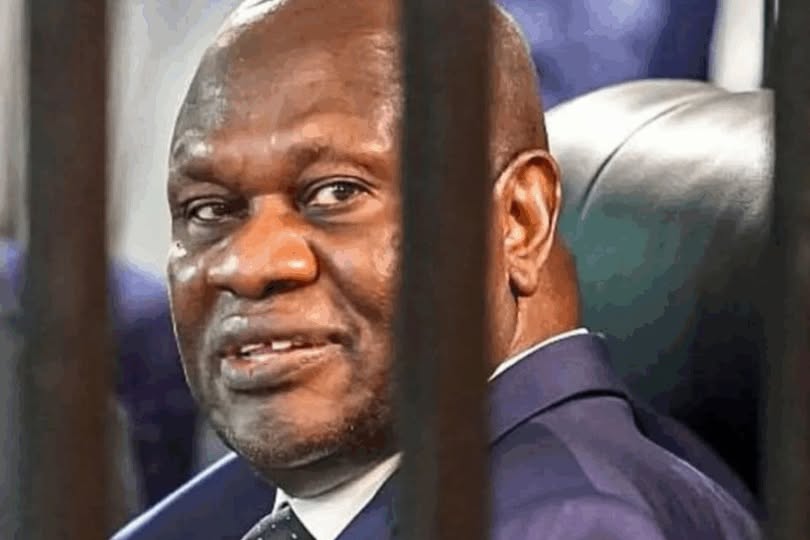
The trial of First Vice President Dr. Riek Machar Teny and seven other senior SPLM/A-IO members continued on Monday as the Special Court on the Nasir Incident held its 31st session at Freedom Hall, during which the prosecution presented testimony from its second and third witnesses.
The court proceedings focused largely on the failed evacuation of South Sudan People’s Defence Forces (SSPDF) personnel from Nasir County, Upper Nile State, following intense fighting that erupted in early March 2025.
The prosecution’s second witness, Brigadier General Santino Akot Abiem, a member of the Joint Verification Monitoring Mechanism (JVMM), was cross-examined by both the defense and the court panel.
Gen. Abiem told the court that he was tasked with coordinating the evacuation of SSPDF soldiers who became stranded after armed youth overran the Wech-Yar-Adiu garrison in Nasir on March 6, 2025.
Responding to questions from the defense, Gen. Abiem said he received a verbal request on March 4, 2025, from the Chief of Defence Forces (CDF), General Paul Nang, instructing him to coordinate with international partners to facilitate the evacuation.
He explained that the request was issued verbally because the area in question was under the control of opposition forces, adding that he would normally issue written instructions only for operations conducted in areas under SSPDF control.
The witness denied having any knowledge of a proposal allegedly submitted by Dr. Machar to evacuate the forces using a civilian aircraft.
He stated that the evacuation report he authored was based on recommendations from the CDF and information gathered through coordination with international actors.
Gen. Abiem further testified that coordination between the International Committee of the Red Cross (ICRC) and the United Nations Mission in South Sudan (UNMISS) was limited, with only one in-person meeting held, while subsequent discussions were conducted by phone.
He added that UNMISS had begun engaging with the Intergovernmental Authority on Development (IGAD) and the Office of the President in an effort to secure safety guarantees for the evacuation.
He told the court that his coordination took place with UNMISS headquarters near Juba International Airport, with a UN field officer in Malakal, and with the Nasir County Commissioner, James Gatluak Lew, on the ground in Nasir.
When asked whether a comprehensive report was produced following the failure of the evacuation operation, Gen. Abiem said no such report was prepared.
The witness also claimed that he coordinated with the head of the UN field office in Malakal, who, according to him, was in contact with the fifth accused in the case, Dr. Riek Machar.
However, he acknowledged that he had no information regarding any investigation conducted by the United Nations into the incident.
He said he received an official letter from the Ministry of Foreign Affairs indicating that a high-level UN delegation from New York would travel to South Sudan to investigate the Nasir incident, but a subsequent letter postponed the visit indefinitely.
Following the defense cross-examination, the court panel questioned Gen. Abiem directly. He confirmed that he had never visited Nasir and had never met or held discussions with Dr. Machar.
He told the judges that his report relied on data provided by UNMISS, including video footage and maps.
Asked whether he had information linking the remaining accused persons to the Nasir incident, Gen. Abiem said he had no information regarding any of them apart from the fifth accused.
On the issue of security guarantees, Gen. Abiem testified that the Red Cross had requested assurances for the safety of its aircraft, crew, and representatives who were expected to supervise the evacuation.
He alleged that these guarantees were provided by the Dr, Machar. Despite this, he said the Red Cross later declined to participate in the operation, citing a lack of trust in the Nasir County Commissioner and the SPLA-IO field commander.
He further alleged that Dr. Machar directed the Nasir Commissioner and SPLA-IO Brigadier General Koang to oversee the evacuation process and that the guarantees were issued in Dr. Machar’s capacity as Chairman and Commander-in-Chief of the SPLM/A-IO.
Third Witness Testimony
The court also heard testimony from the prosecution’s third witness, Captain Joseph Malong Akot, an SSPDF military intelligence officer who was among the soldiers evacuated from Nasir on March 6.
Captain Akot told the court that clashes between SSPDF forces and opposition elements began in mid-February 2025, following reports of large-scale mobilization by opposition forces in Nasir.
He said the late Major General David Majur Dak ordered SSPDF units to prepare after intelligence indicated increased deployments on February 28, with mobilization continuing until March 1.
According to the witness, the first major attack on the garrison occurred on March 2 at around 11:00 p.m., led by the late Tor Gile Thoan and his deputy, Kang Makana, and continued until dawn.
He testified that Tor Gile returned the following morning to lead another assault but was killed during the fighting.
Captain Akot said he personally saw Tor’s body and identified him as wearing an SPLA-IO uniform with the rank of colonel.
He further stated that on March 4, another attack was launched, this time led by Kang Makana, forcing SSPDF soldiers to scatter within the garrison and take refuge inside armored personnel carriers (APCs).
Captain Akot said he received a call from Major General Majur Dak, who instructed him not to abandon his position or trust any offers of food or water from the White Army, warning that such offers were intended to lure soldiers out of their armored vehicles.
Captain Akot testified that on the first day of the evacuation attempt, he was informed by army command that aircraft were en route to evacuate the stranded troops to Malakal.
He said the Nasir County Commissioner contacted him to assure him that local chiefs would assist in ensuring safe boarding.
However, he alleged that when the soldiers exited the APCs to board the aircraft, they came under gunfire from the White Army.
He said he placed a white cloth on top of the armored vehicle to help the evacuation team identify their location, but the troops were attacked by both the White Army and SPLA-IO forces during the boarding process.
The witness told the court that he was the last soldier to board the aircraft after a violent confrontation and that the soldiers were forced to leave Major General Majur behind, as he was approximately half a kilometer away and surrounded by hostile forces.
Under questioning from the defense, Captain Akot said he did not see any of the accused persons present in Nasir on the day of the incident.
At the close of the session, the court adjourned proceedings until Wednesday, December 17, when it is expected to continue questioning the third witness.
The trial of Dr. Riek Machar and his co-accused remains one of the most closely watched legal cases in South Sudan, with significant political and security implications.