
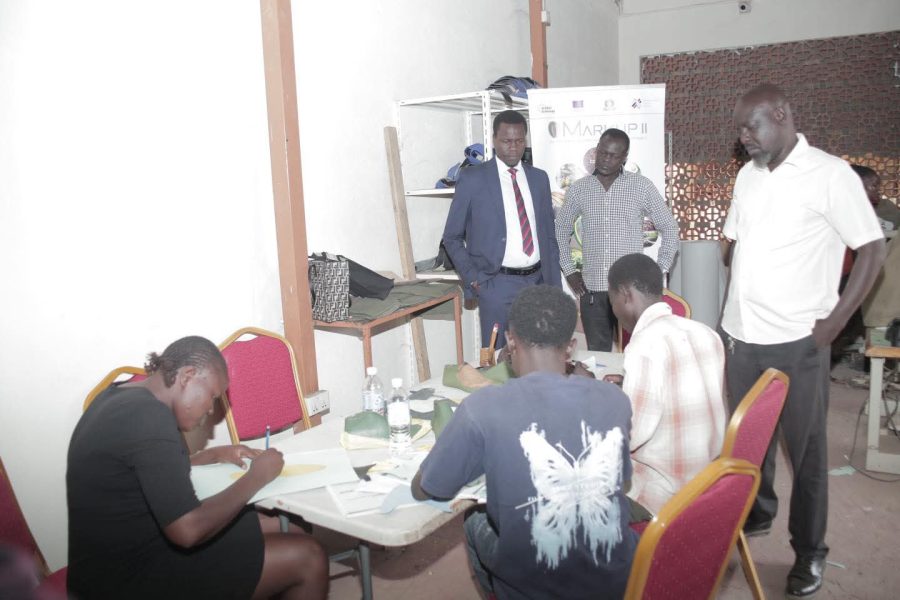
In a modest workshop in Juba, the sound of cutting tools and sewing machines marked more than the end of a seven-day training program it signaled the early steps of a youth-driven push to build South Sudan’s own leather and footwear industry.
Twenty young people have completed an intensive hands-on course in shoe production, gaining practical skills aimed at reducing dependence on imported leather goods while opening new paths to self-employment.
The training was delivered through a partnership between Salaam Junub, the International Trade Centre, Mayo Company, and the South Sudan Leather and Product Association.
Hosted at Mayo Company, currently the country’s only leather-producing enterprise founded and run by local youth, the program focused on the full footwear value chain from design and cutting to stitching, finishing, and basic business principles.
Bush Buse, Executive Director of Salaam Junub, said the initiative responds to a long-standing contradiction in South Sudan’s economy.
Despite the country’s vast livestock population and steady supply of animal hides, there is no functional tanning industry, forcing local producers to import finished leather from regional markets such as Kenya.
At the same time, raw hides are exported out of the country with little value added locally.
“This is both a challenge and an opportunity,” Buse said, noting that the high cost of tanning machinery and limited access to capital have slowed investment in the sector. “If we establish a tanning industry here, we can produce shoes, bags, belts, and other leather products locally at lower prices. That means jobs, skills transfer, and stronger economic self-sufficiency.”
Participants in the training reflected the diversity and ambition of South Sudan’s youth.
Among them was Dusman Betty Steven, a 27-year-old medical graduate currently interning at Juba Military Hospital, who said professional qualifications should not restrict practical ambition.
She described the training as empowering, particularly for young women often discouraged from pursuing technical skills.
“With this training, you can easily be independent,” she said. “You cannot wait for somebody to employ you.”
She encouraged women not to allow marriage or social expectations to prevent them from learning income-generating skills.
Another trainee, Samuel Luate Khamis, an economics student at Jamajuba, said the program demystified the entire process of shoe production. “We learned everything from start to finish,” he said. “You cannot learn something and leave it to die. It’s good to put it into practice.”
Khamis said he hopes to train other youth and eventually open his own workshop, though he acknowledged that access to finance remains a major hurdle.
Beyond individual success stories, participants called for longer training periods, advanced modules, and start-up support to help them expand into other leather products and scale their operations.
Organizers say such feedback underscores the need for sustained investment if South Sudan is to move from small-scale craftsmanship to a competitive local industry.
While modest in size, the program represents a meaningful step toward value addition, youth employment, and import substitution.
As the newly trained artisans leave the workshop with skills in their hands and business ideas in mind, they embody a simple but powerful idea: the future of South Sudan’s leather industry may begin, quite literally, from the soles up.