
The government of South Sudan has approved a $2 billion national roads development project as the country edges closer to general elections.
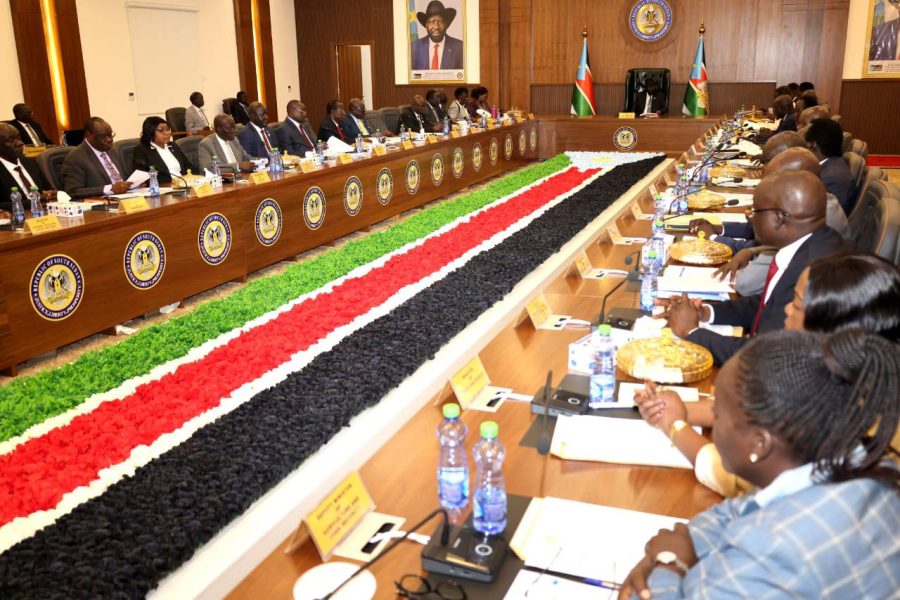
The decision was reached during a regular meeting of the Council of Ministers chaired by President Salva Kiir, where the Cabinet endorsed the use of the country’s gold reserves as collateral to finance the massive road construction program.
Under the approved plan, the Cabinet granted a sovereign guarantee to Shamrock Global Group to construct and upgrade more than 1,031 kilometers of strategic national roads to asphalt standard.
The project targets key economic and security corridors linking major towns and border areas.
Among the roads earmarked for upgrade are the Juba–Yei–Kaya and Yei–Faraksika–Maridi routes, the Juba–Lobonok–Moli Junction Road, and the Wau–Raja–Boro Medina corridor, all considered critical for trade, movement, and national integration.
Speaking to the press after the meeting, Information Minister Ateny Wek Ateny said the Cabinet viewed the project as a turning point for infrastructure development in the country.
“This is a historic decision by the Council of Ministers. It reflects the government’s determination to address long-standing infrastructure gaps and to open up the country through improved road connectivity,” Ateny said.
He disclosed that the total cost of the project stands at $2 billion, with the construction of each kilometer estimated at an average of $2.3 million, citing terrain challenges and the need for durable asphalt standards.
The initiative was proposed by the Minister of Mining, Lasuba Ludoru Wongo, who advanced the idea of leveraging gold reserves to accelerate development without immediate budgetary strain.
According to Minister Ateny, the government believes the approach will allow South Sudan to utilize its natural resources to unlock delayed development priorities, particularly in infrastructure, which has lagged behind since independence.
“The use of gold as collateral is intended to ensure that the country’s resources directly contribute to development that benefits the people,” he explained.
The information minister also linked infrastructure development to broader national stability, stressing that peace and security remain central to the government’s agenda as the country moves toward elections.
“Security is fundamental. Without peace and stability, infrastructure development and a credible democratic transition cannot be sustained,” Ateny said.
The $2 billion roads project now stands as one of the largest infrastructure investments approved by the government, raising expectations among citizens while also drawing attention due to its timing, as South Sudan prepares for an election period following years of delayed development commitments.