
South Sudan Football Federation (SSFF) is turning inward in a bid to revive the country’s struggling game, placing emphasis on developing local coaching talent as both a practical necessity and a long-term reform strategy.
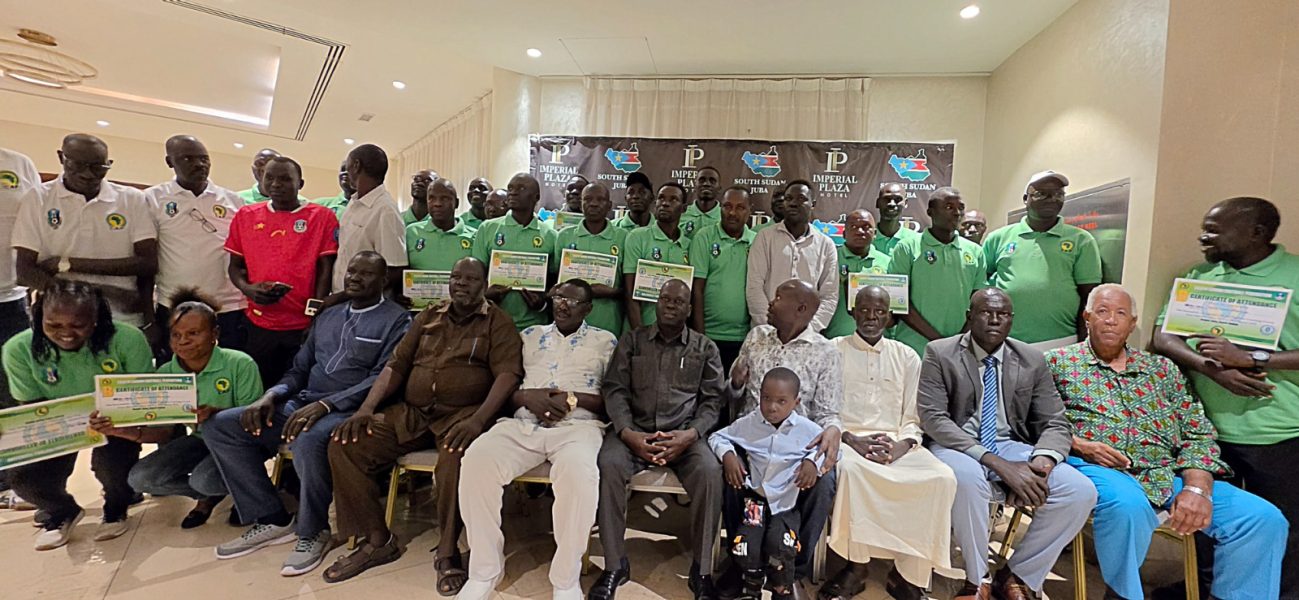
The shift comes after 24 candidates completed a four-month CAF B Licence coaching course in Juba last week, the first major national coaching programme since 2014.
“We cannot keep on waiting for people to come from outside to develop football in this country,” said Dr. Peter James at the graduation ceremony. “Our intention is to localise or nationalise our coaches.”
The course, which ran from November 10 to March 19, delivered more than 478 hours of training-far exceeding the global minimum standard of 160 hours-and was designed to close a technical gap officials say has long undermined the sport’s development.
South Sudan’s senior national team, the Bright Stars, has struggled to establish itself since the country’s independence in 2011. The team remains among the lower-ranked sides in the FIFA World Rankings and has endured more defeats than victories in recent regional and World Cup qualifying campaigns.
“People are talking that our national team is not delivering,” Dr. James said. “If we ask ourselves the reason, we find that we have very poor coaches who are leading the process of coaching.”
The country’s football system is still in its infancy. SSFF was admitted to the Confederation of African Football and FIFA in 2012, and the national team has yet to qualify for a major continental tournament.
For officials, investing in local coaches is not only a strategic choice but also a financial reality.
“We have full dependence on the local national coaches. We do not spend on foreigners,” said Makur Majok, the First Vice President of the federation, pointing to budget constraints that make long-term foreign hires unsustainable.
SSFA President Francis Amin Michael acknowledged the scale of the challenge, saying progress has been slow but reforms remain on course.
“We are still far behind, we still have a long way to go,” he said. “We don’t have the means to carry out the desired projects.”
He called for unity across the football community to ensure that the newly trained coaches translate knowledge into results on the pitch.
“We will fight until we make sure that our goals have been achieved,” he added.
Among the graduates is Lilian Prima, one of the few female coaches working at the top level of South Sudanese football. Prima, who leads Simba FC in Juba’s first division, said the course had significantly sharpened her tactical and managerial approach.
“With the courses that we have for four months… we have been learning different formations, how to manage players, how to win games,” she said.
Still, officials acknowledge that coaching alone will not transform the game overnight.
South Sudan’s challenges run deeper, from limited competitive exposure and a still-developing domestic league to chronic resource constraints that place it at a disadvantage against more established football nations.
Yet the federation believes that investing in homegrown expertise offers the most sustainable path forward.
By strengthening coaching at grassroots and club level, officials hope to gradually raise standards across the national game.
“It’s about building from the grassroots so that we prepare future players for the national team,” Dr. James said. “Without the training of coaches, I think that our dream is lost every time.”