
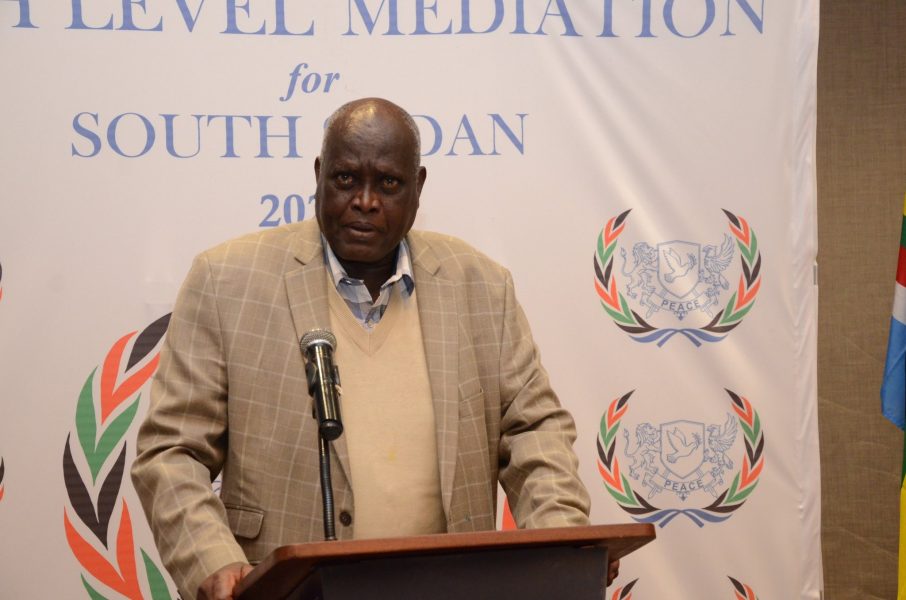
South Sudan’s government has reversed its earlier decision to disengage from the Kenya-facilitated Tumaini Peace Initiative, formally rejoining the process in what describe as a significant political U-turn amid mounting regional and international pressure.
On January 29, 2026, the Chief Facilitator of the Tumaini Initiative, Lt. Gen. Lazaro Sumbeiywo (Rtd), handed over a Framework for Dialogue to the Special Envoy of President Salva Kiir Mayardit in Nairobi.
The framework is intended to guide deliberations on a draft South Sudan National Consensus Charter for Peace and Democracy, marking the government’s renewed participation in the initiative it had previously withdrawn from.
The Tumaini Initiative also presented the framework to opposition leaders, including the SPLM-IO, the United Peoples’ Alliance (UPA), members of the South Sudan Opposition Movements Alliance (SSOMA), and representatives of civil society and the South Sudan Council of Churches.
The broad engagement signals a renewed push for an inclusive, South Sudanese-owned dialogue process after months of uncertainty surrounding the initiative’s future.
The government’s earlier withdrawal from the Tumaini process had raised concerns among regional mediators and civil society groups, who warned that abandoning the talks risked deepening political deadlock, prolonging the transition, and undermining prospects for credible elections.
The return is now being framed by facilitators as a critical step toward rebuilding trust and restoring momentum in the peace process.
According to the framework, the forthcoming dialogue departs from adversarial negotiations and zero-sum politics, instead promoting a people-centred, non-hierarchical approach in which all stakeholders participate as equal partners.
Participants are expected to prioritize national interests over narrow political, sectarian, or ethnic agendas, with a focus on peace, security, accountable governance, and democratic choice.
Substantively, the dialogue will address the cessation of hostilities, civilian protection, stabilization, and humanitarian access, while laying the groundwork for long-term reforms to be handled by an elected government.
These include permanent constitution-making, transitional justice, security sector reform, unification of forces, disarmament, demobilization and reintegration (DDR), and durable solutions for refugees and internally displaced persons.
The Tumaini Initiative builds on lessons learned from the implementation challenges of the 2018 Revitalised Agreement on the Resolution of the Conflict in South Sudan (R-ARCSS), seeking to overcome persistent political stalemates and cycles of transitional extensions.
Facilitators say the process responds to widespread public demands for accountable leadership, improved economic conditions, and a definitive end to recurring conflict.
The dialogue will be convened within a regional framework under the stewardship of IGAD, with support from international partners.
Deliberations on the draft National Consensus Charter are expected to conclude within four weeks, setting the stage for what proponents hope will be a more credible and sustainable path toward elections and post-transition stability.
