South Sudan’s oil production has climbed to approximately 174,000 barrels per day, marking a significant milestone for the country’s petroleum industry and signaling renewed momentum in a sector that remains the backbone of the national economy.
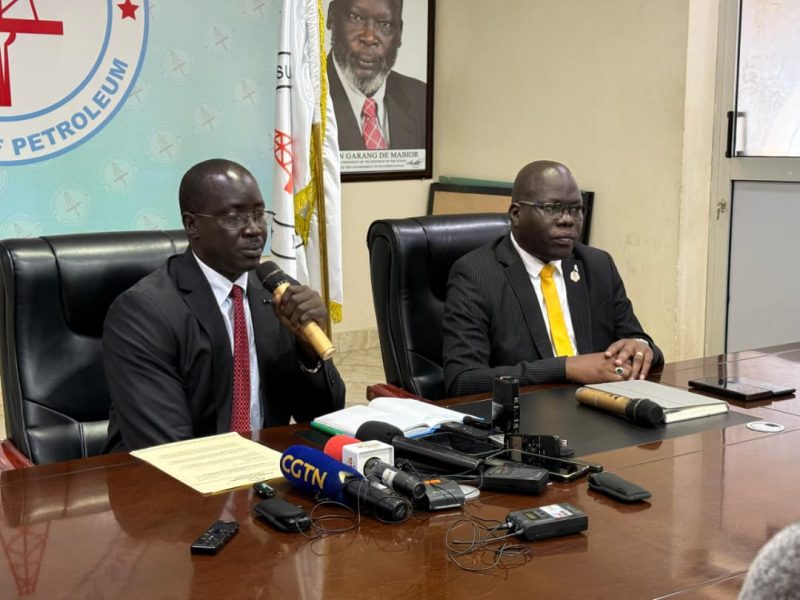
The achievement was announced on Thursday by the Ministry of Petroleum during a ceremony in Juba recognizing the efforts of oil operators and industry stakeholders who have contributed to increasing production across the country’s key oil-producing regions.
Speaking at the event, the Undersecretary of the Ministry of Petroleum, Eng. Dr. Santino Ayuel Longar, described the latest production figures as a testament to the resilience of South Sudan’s oil sector and the success of ongoing efforts to maximize output from mature oil fields.
“Today we celebrate not merely a production milestone, but a testament to vision, resilience, innovation and professional excellence,” Dr. Ayuel said.
“This achievement reinforces confidence in the future of South Sudan’s petroleum sector.”
According to the Ministry, the increase has been driven largely by improved performance across major operating companies, particularly the Greater Pioneer Operating Company (GPOC), whose production has risen to 60,158 barrels per day.
Dr. Ayuel noted that the milestone reflects years of investment in infrastructure, technical expertise, and the implementation of innovative production enhancement strategies designed to sustain output from fields that have been producing for more than two decades.
He revealed that the government first briefed President Salva Kiir Mayardit on the development before making the announcement public, in line with official government procedures.
“When working in government, there are procedures that must be followed. The Head of State must be informed and updated so that all institutions remain aligned. Following the briefing to the President, we were able to share this achievement with the public,” he said.
Despite the positive development, officials acknowledged that increasing production has not been without challenges. Many of South Sudan’s oil fields are considered mature assets and experience natural production declines over time.
Some fields are estimated to lose as much as 25 percent of their output annually, requiring continuous investment in drilling, enhanced oil recovery programs, well interventions, and facility upgrades.
The Ministry said operators have managed to counter these declines through improved reservoir management, technological innovations, and production optimization initiatives.
Newly developed infrastructure alone has added more than 6,000 barrels per day to national output.
Providing a breakdown of production figures, Director General for Petroleum Exploration and Production, Eng. Lual Chol Dak, said Dar Petroleum Operating Company (DPOC), which operates Blocks 3 and 7 in Paloch, currently produces approximately 100,000 barrels per day.
GPOC, operating in Blocks 1, 2 and 4 in Unity State, contributes more than 60,000 barrels per day, while Sudd Petroleum Operating Company (SPOC) produces about 14,000 barrels per day from the Tharjath oil fields.
“The total production is now approximately 174,000 barrels per day, and we are working to increase production beyond this level,” Lual said.
Officials noted that the sector continues to face a range of obstacles, including aging infrastructure, declining reserves, rising operational costs, supply chain constraints, and security concerns in some oil-producing areas.
They also highlighted disruptions linked to regional instability, particularly along export routes through Sudan, which remain vital for transporting South Sudanese crude to international markets.
Nevertheless, industry leaders expressed confidence that continued investment and innovation will help sustain production growth.
Speaking during the ceremony, GPOC President He Yanhui said the company remains focused on maintaining current production levels while pursuing further expansion through technology and operational efficiency.
“We are trying to sustain current production while managing all risks in the field,” Yanhui said. “We are applying technology, improving efficiency and working together with our partners to ensure stable operations and future growth.”
Oil remains South Sudan’s most important economic resource, accounting for the vast majority of government revenue and foreign exchange earnings.
While national production remains below the levels recorded shortly after independence, officials say the latest gains demonstrate the sector’s capacity to recover and expand despite ongoing challenges.
The Ministry of Petroleum said it will continue collaborating with operating companies, investors, and development partners to increase production, maximize recovery from mature fields, and support new exploration activities aimed at strengthening the industry’s long-term contribution to economic growth and national development.