
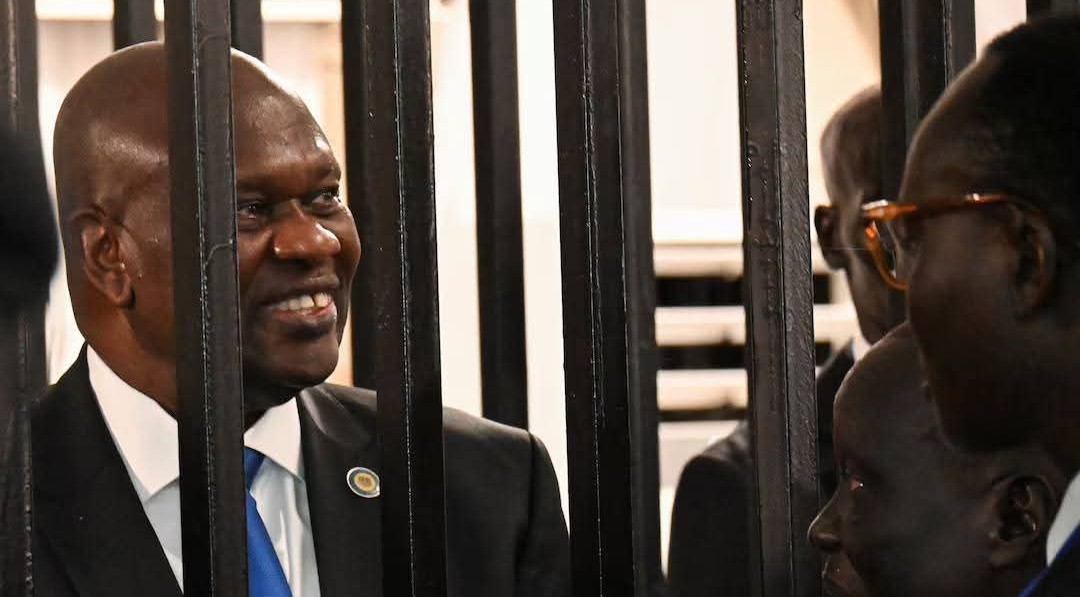
The Special Court on the Incident of Nasir on Friday heard testimony from a digital forensics expert presented by the prosecution as it continues the trial of First Vice President Dr. Riek Machar and senior leaders and members of the SPLM/A-IO.
The court, sitting for its 45th session at Freedom Hall, received evidence from Mr. Peter Ratlhogo Calvin, a South African digital forensic analyst hired by the government to extract and analyse electronic data from mobile phones and laptops belonging to Dr. Machar and other SPLM/A-IO detainees.
Calvin, the prosecution’s 13th and final witness, told the court that he conducted a technical examination of digital material submitted as evidence by Major General Thomas Basilio Wani, the lead investigator in the case.
He said the analysis covered thirteen digital exhibits, including WhatsApp messages, images, videos, GPS location data, SIM cards, memory devices and laptop computers.
According to the witness, the electronic devices were handed to him in Johannesburg on 25 June 2025 in a sealed diplomatic briefcase, following a request from South Sudan’s Ministry of Foreign Affairs seeking assistance with digital forensic analysis.
He told the court that after creating forensic images and scanning the devices in his laboratory, he concluded that the material contained evidence of organised criminal activity.
Calvin alleged that the data included documents and multimedia files related to weapon procurement, coordinated militia planning, confidential operational intelligence, real-time document sharing, and the alleged involvement of foreign entities.
He further testified that once the analysis was completed, the devices were resealed in a diplomatic briefcase and returned to South Sudan.
He said he arrived in Juba on 28 August 2025, where he submitted his final report allegedly authenticated by South Africa’s Department of International Relations and Cooperation and the South Sudanese embassy in Pretoria to Major General Wani in the presence of members of the investigation committee.
However, since the start of proceedings last year, the defence has challenged the legality and credibility of the digital evidence, arguing the devices were seized during unlawful arrests without court-approved search warrants.
Defence lawyers argued that the devices were illegally obtained and later transferred to a private digital forensics company in South Africa, reportedly owned by the prosecution witness himself, bypassing established international judicial cooperation procedures.
They said the transfer occurred without formal technical or judicial assistance agreements between South Sudan and the Republic of South Africa.
The defence further noted that Mr. Denis Dumo, the diplomat who transported the devices to South Africa in a diplomatic briefcase, is an official of the Ministry of Foreign Affairs and International Cooperation but not a member of the investigation committee chaired by Major General Wani, raising additional questions about the chain of custody.
Presiding judge James Alala Deng adjourned the proceedings until Monday, 2 February, when the prosecution witness is expected to return to court to further explain and clarify his alleged findings.