
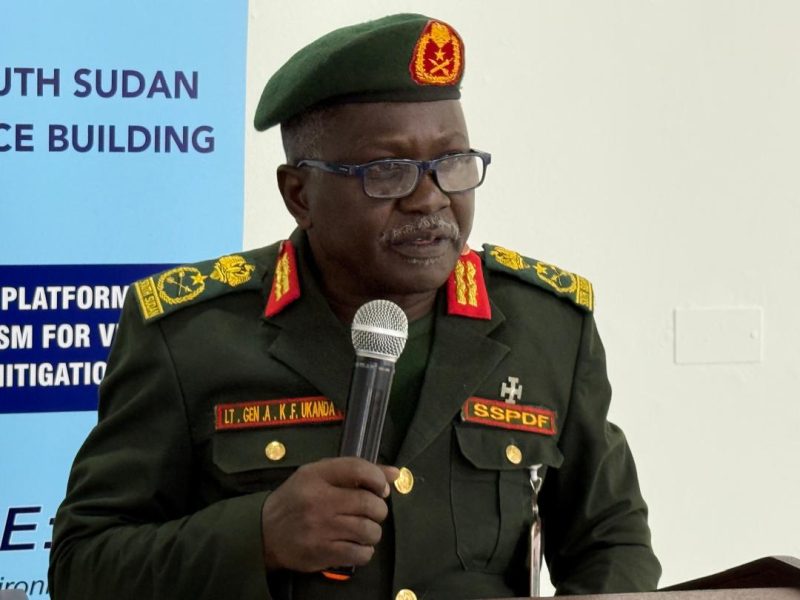
A senior general of the South Sudan People’s Defence Forces has called on political leaders to hold a retreat and engage in inclusive dialogue, warning that lasting peace in South Sudan depends on cooperation, reconciliation, and dialogue ahead of elections.
Lt. Gen. Ashhab Khamis Fatal, a senior general of the SSPDF and Assistant Chief of Defence for Moral, Orientation and Chaplaincy, has suggested a leaders’ retreat and inclusive national dialogue as key measures to prevent electoral violence and promote political stability.
Representing the army at the workshop, Lt. Gen. Ashhab made the remarks during the closing ceremony of a two-day national elections workshop, which focused on strengthening mechanisms for violence prevention and mitigation.
He said elections must be treated as a process that requires restraint, moral responsibility, and dialogue among political actors.
“A peaceful process begins with stability, and stability must be our top priority as a nation,” Lt. Gen. Ashhab said.
“Without stability, there will be no development and no meaningful progress for our people.”
He said a leaders’ retreat would provide political actors with space to reflect honestly on the country’s fragile context, resolve differences through dialogue, and recommit themselves to peaceful political competition.
“We must speak to the hearts and minds of our leaders,” he added. “If dialogue replaces confrontation, many of the tensions that threaten peace can be avoided.”
The general further noted that members of the organised forces, despite wearing uniform, are also citizens who want peace for their families and communities.
“As people in uniform, we are also human beings,” he said. “We want our children to go to school safely and enjoy life like every other citizen.”
Lt. Gen. Ashhab reaffirmed the SSPDF’s commitment to professionalism and neutrality, pledging that security forces will protect civilians and safeguard a peaceful political environment throughout the electoral period.
“We are committed to ensuring the safe arrival of the country at the destination of elections,” he said. “Our duty is to protect peaceful solutions and prevent violence.”
Pia Philip Michael, Undersecretary at the Ministry of Peacebuilding, highlighted the human cost of violence and called for reconciliation, forgiveness, and responsible leadership.
“One single gunshot can destroy many lives in one day,” Pia said. “We have lost civil servants, doctors, and professionals because of violence, and that loss continues to affect our country.”
He urged communities to rethink harmful cultural practices that glorify violence, stressing that strength should be measured by the ability to protect peace rather than engage in conflict.
“Some of our cultural beliefs are no longer fit for purpose today,” he said.
“Teaching our children that violence makes them strong is wrong. True strength is protecting the community and choosing peace.”
Pia also appealed to political leaders and youth to reject violence and hate speech, particularly on social media platforms.
“Our politicians must be peacemakers, not promoters of violence,” he said.
“And our young people must stop hate speech and ethnic labeling on social media. This country belongs to them, and the future they destroy today is the one they will live in tomorrow.”
He emphasised that reconciliation and dialogue are essential if the country is to conduct peaceful elections.
“We cannot achieve peace without reconciliation,” Pia said. “People have grievances, and they need space to talk, to listen, and to find better ways of living together.”
The workshop brought together a broad range of peace and electoral stakeholders, including senior organised forces officials, civil society organisations, youth and women leaders, church leaders, parliamentarians, and other national actors.
Discussions focused on early warning systems, conflict prevention, dialogue-based approaches, and coordination among institutions to mitigate election-related violence.
The event was organised by the Ministry of Peacebuilding with support from the African Union.
Organisers said the engagement aimed to strengthen national preparedness for elections through inclusive participation and shared responsibility.
At the conclusion of the workshop, participants called for sustained dialogue among political leaders, stronger collaboration between state institutions and civil society, and concrete follow-up actions to ensure elections are conducted in a calm, inclusive, and non-violent environment.