
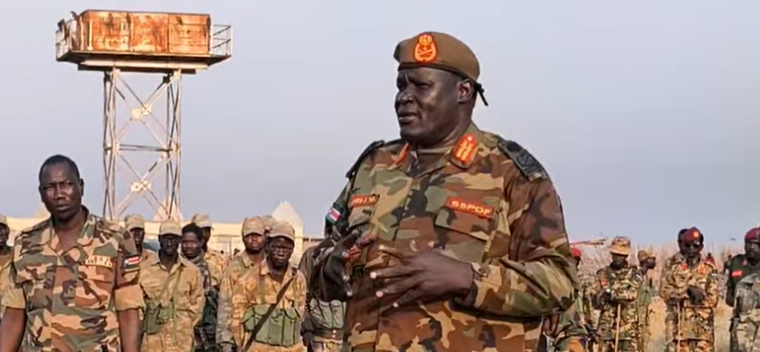
Human rights activists have raised grave alarm following incendiary remarks attributed to a senior South Sudan People’s Defence Forces (SSPDF) commander, warning that such rhetoric could fuel mass civilian killings and grave international crimes if left unaddressed.
The Community Empowerment for Progress Organization (CEPO) on Sunday strongly condemned statements reportedly made by General Johnson Olony, the Assistant Chief of Defence Forces for Mobilization and Disarmament, in which he allegedly instructed forces deployed to Jonglei State to recapture areas held by rival forces while “not sparing anyone,” including the elderly and even livestock.
CEPO Executive Director Edmund Yakani described the remarks as reckless, unacceptable, and deeply dangerous, saying they amount to direct incitement to violence against civilians.
“These words are not casual or emotional expressions. They constitute a concrete seed for grave human rights violations, including war crimes, crimes against humanity, and acts that could amount to genocide,” Yakani said.
According to a widely circulated video, Gen. Olony made the remarks while addressing Agwelek forces in Duk County, Jonglei State, ahead of their deployment to confront SPLA-IO forces and allied armed groups.
In the address, he told fighters not to spare “the elderly, a chicken, a house or anything,” framing the operation as a decisive end to recurring insecurity in the Greater Upper Nile region.
“When we arrive there, don’t spare elderly, don’t spare a chicken, don’t spare a house or anything,” Gen. Olony told his forces.
Rights groups say such language promotes dehumanization and removes restraints on soldiers, placing civilians particularly women, children, and the elderly at extreme risk.
Yakani noted that references to destroying everything, including animals and homes, reflect hate speech and implicitly authorize looting, forced displacement, and extrajudicial killings.
“Soldiers are constitutionally mandated to protect civilians, not threaten their existence,” Yakani said. “This rhetoric directly contradicts the Bill of Rights, international humanitarian law, and the SSPDF’s own professional code of conduct.”
General Olony, who also commands the Agwelek militia partially integrated into the SSPDF, was appointed to his current position by President Salva Kiir in January 2025.
His appointment was controversial, given his history of repeated defections, armed clashes, and longstanding allegations of serious human rights abuses during previous conflicts.
The remarks come amid heightened insecurity in Jonglei and the wider Greater Upper Nile region, where fighting has repeatedly displaced civilians and destroyed livelihoods.
The area has a long history of ethnically driven violence, with civilians consistently bearing the brunt of military operations.
International observers have repeatedly warned that inflammatory rhetoric by commanders often precedes spikes in atrocities.
The United Nations Mission in South Sudan (UNMISS) and other monitoring bodies have in the past linked similar language to increased incidents of killings, sexual violence, looting, and forced displacement.
CEPO has called on President Salva Kiir, in his capacity as Commander-in-Chief of the SSPDF, to urgently intervene, investigate the reported remarks, and ensure accountability.
The organization is also demanding a public apology from Gen. Olony and the formal withdrawal of the statement by SSPDF leadership.
“Failure to act decisively risks normalizing incitement within the armed forces and exposing the country to international accountability mechanisms,” Yakani warned. “South Sudan cannot afford another cycle of violence fueled by irresponsible leadership.”
As tensions remain high on the frontlines, rights groups say the government’s response to the controversy will be a critical test of its commitment to civilian protection, rule of law, and preventing further atrocities in a country still struggling to emerge from years of conflict.