
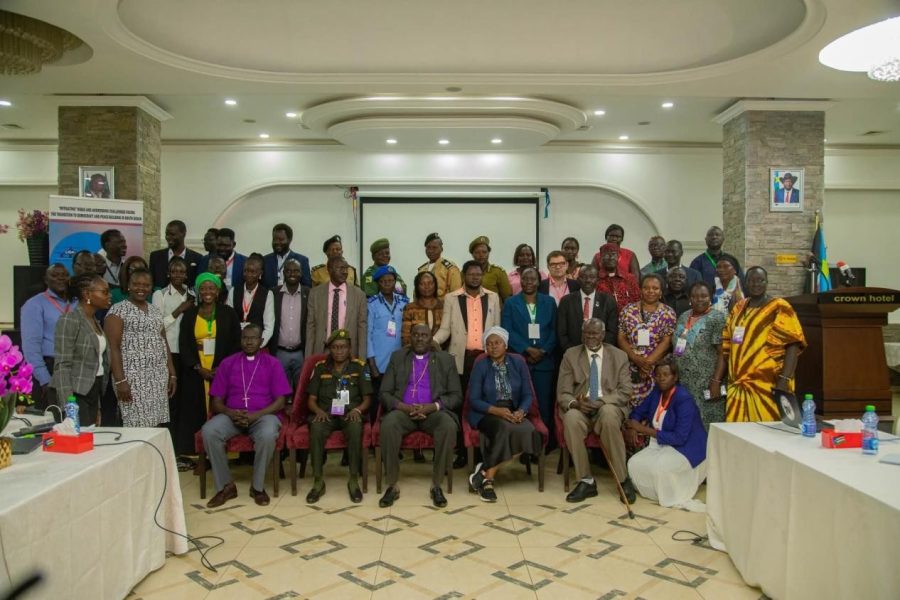
A National Stakeholders’ Consultative Dialogue is currently underway in Juba, gathering over 80 representatives from government, civil society, faith-based institutions, and development partners.
The three-day forum from 19-21 November 2025 aims to address implementation gaps in the 2018 Revitalized Agreement on the Resolution of Conflict in the Republic of South Sudan (R-ARCSS) and chart a viable path toward democracy.
Organized by the Centre for Inclusive Governance, Peace and Justice (CIGPJ) in collaboration with the South Sudan Civil Society Forum (SSCF) and the UN-Women South Sudan Country Office, the dialogue seeks to reduce political tensions, mitigate transition risks, and counter hate speech.
Officially opening the event, Mary Nawai, National Minister of Youths and Sports, emphasized that the dialogue must be more than just a ceremonial event.
She described it as a vital platform for collective reflection, honest conversation, and coordinated action to tackle the complex and unfinished journey toward peace.
“Although significant progress has been made through the implementation of a revitalized agreement on the resolution of conflict in South Sudan, our nation is still crippled with many things that we really need to address as the people of South Sudan,” Minister Nawai stated.
She highlighted recurring local violence, political instability in the states, economic hardship, and weak institutions as urgent challenges requiring a coordinated response.
Minister Nawai further stated that while young people constitute more than two-thirds of the population, she warned that leaving youth vulnerable to unemployment and trauma contributes to cycles of violence.
“The youth of South Sudan are the greatest stakeholders in our peace and our future,” Nawai said. “We must make our young people not just participants, but leaders in South Sudan’s transition to peace and democracy.”
She further acknowledged the essential role of women as mediators and community stabilizers, pledging her Ministry’s continued support for gender equality and the use of sports to bridge ethnic and political divides.
“The Ministry of Youth and Sport stands firmly in support of gender equality, and we will continue to collaborate on programs that empower young women and promote their leadership in sports and peacebuilding initiatives,” she added.
For her part, Jackline Nasiwa, Executive Director of CIGPJ, delivered an assessment of the transition noting that while the 2018 Peace Agreement is the cornerstone for stability, its implementation remains “fragile and sluggish.”
Nasiwa stated statistic from the High-Level Standing Committee, which indicated that only 10% of the Revitalized Agreement has been implemented to date.
“This sobering figure underscores the need for coordinated actions, genuine intentions, and inclusive national consensus,” Nasiwa said.
She added that the postponement of elections to 2026 has further eroded public trust and delayed the prosperity civilians have long awaited.
Nasiwa also criticized the failure to meet the affirmative action quota for women in leadership. “Women’s participation in South Sudan remains below the affirmative action 35% quota,” she noted, calling the strengthening of women’s leadership ‘non-negotiable’ and a fundamental right.
To prevent a return to war, stakeholders outlined several imperative milestones, including unifying and training the national army to de-escalate conflicts.
Strengthening the judiciary and implementing transitional justice for healing and supporting robust constitutional consultation and election preparedness. Establishing local peace structures to monitor violence at the grassroots level.
Nasiwa urged participants to “never give up” and called on international partners, including the Government of Norway and the UN Peacebuilding Fund, to sustain their support.
“Peace is in our hands,” Nasiwa stated. “Only by working together with unwavering commitment can we secure stability and prosperity for our country that we love so dearly.”