
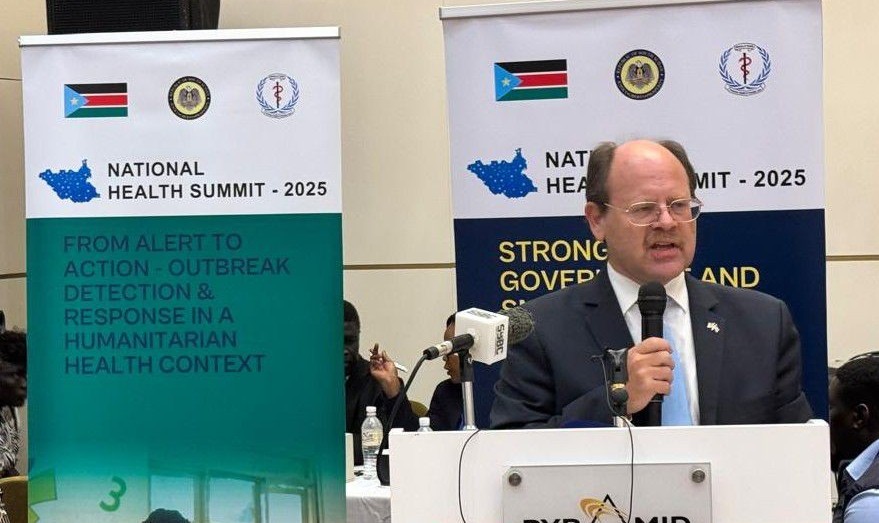
British Ambassador to South Sudan, David Ashley, has urged the government to substantially increase its domestic investment in the health sector, warning that the country’s overwhelming reliance on international aid is no longer sustainable.
Ashley delivered the message on Tuesday while addressing the 2025 National Health Summit in Juba, where he spoke on behalf of global health partners including the World Bank, Global Fund, GAVI, Canada and the European Union.
In his remarks, the Ambassador praised the “professionalism, stoicism and dedication” of South Sudan’s health workers, many of whom continue to serve communities despite shortages of medicines, equipment, and delayed salaries.
However, he noted with concern that up to 85% of functional health services in the country are funded by donors, mostly through the Health Sector Transformation Project (HSTP).
Ashley told delegates that during his recent visit to Kator Primary Health Care Centre and Al Sabah Children’s Hospital in Juba, he witnessed how dependent the system has become on foreign and charitable support even for basic supplies.
“This level of dependence, frankly, cannot continue,” he emphasized.
According to the Ambassador, global aid budgets are under severe pressure, and donor contributions to South Sudan have already begun to decline.
The UK alone has contributed over USD 800 million through the Health Pooled Fund since independence, but future assistance will not match previous levels.
“This makes it even more critical,” Ashley said, “to ensure every dollar or South Sudanese Pound allocated to health is used effectively, transparently, and in the highest-impact areas.”
He called on the government to prioritise health in its national budget, ensure consistent salary payments to health workers, and take full ownership of maintaining critical infrastructure such as oxygen plants, incinerators and diagnostic equipment previously built with donor funds.
Ashley also highlighted ongoing challenges undermining the sector, including the high turnover of technical personnel, procedural delays in key agreements under HSTP, and the need for stronger focus on sexual and reproductive health to reduce maternal mortality.
Beyond health financing, the Ambassador stressed that peace remains the most fundamental requirement for progress.
He condemned the violence that has killed and displaced thousands this year, damaged hospitals, and diverted national resources from essential services to military operations.
“As partners, we remain committed to supporting South Sudan,” Ashley concluded, “but genuine progress depends on renewed government commitment, increased domestic resources, and lasting peace.”