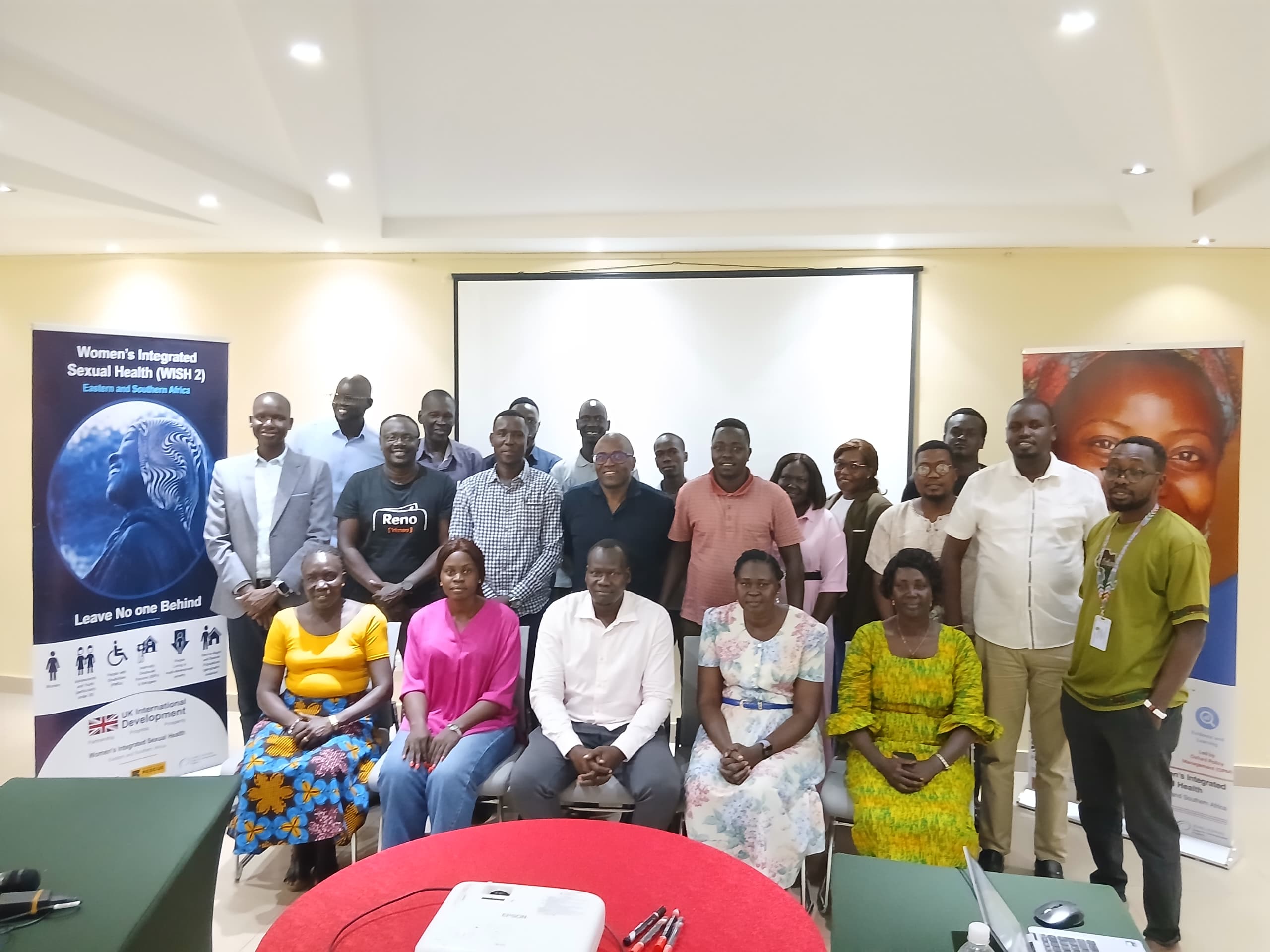
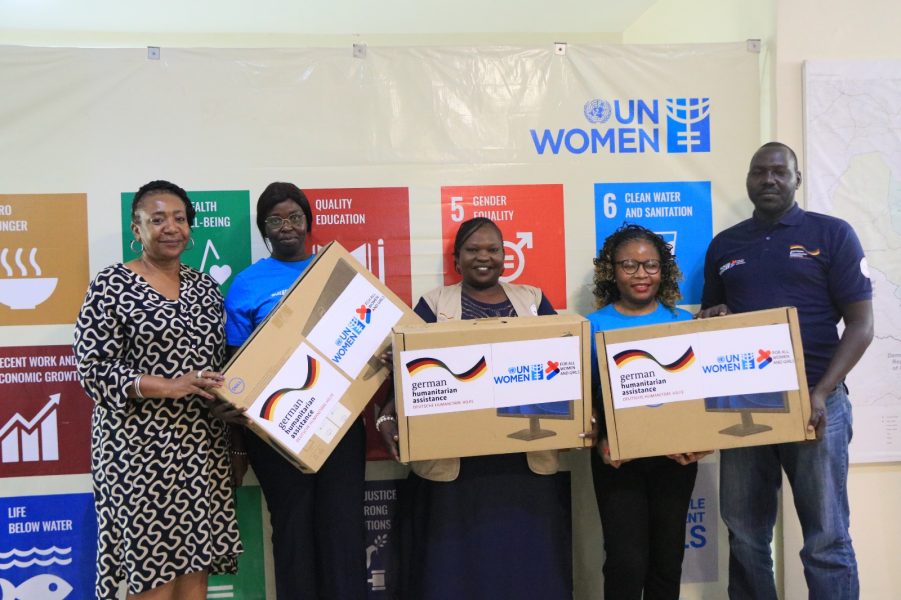
UN Women has provided office equipment to three women-led organizations in South Sudan in a move aimed at strengthening grassroots institutions working to promote women’s rights, gender equality and protection services across the country.
The support, announced during a handover ceremony in Juba, is part of UN Women’s Promoting Localized Gender Accountability to Address Inequality and Gender-Based Violence in Humanitarian Crises project, which seeks to build the institutional capacity of local organizations at the forefront of humanitarian response.
The beneficiary organizations TTi Foundation, Health Education South Sudan (HESS) and Women Advocacy for Child Protection Initiative (WACPI) received desktop computers, monitors, workstations and office chairs to improve their operational capacity and service delivery.
Speaking at the event, UN Women Country Representative Delphine Serumaga said strong local organizations are essential to advancing women’s rights and delivering effective humanitarian assistance.
She said the agency’s investment goes beyond financial support, focusing on building sustainable institutions capable of responding to the needs of women and girls in communities affected by conflict, displacement and other humanitarian challenges.
“Our objective is to build your institutional and operational capacity so that your organizations can better serve women and girls,” Serumaga said.
“We recognize the critical role women-led organizations play in reaching communities, advocating for rights and driving meaningful change at the grassroots level.”
She described local women’s organizations as among the first responders during humanitarian emergencies and said strengthening their capacity is central to UN Women’s commitment to localization, an approach that seeks to place national actors at the centre of humanitarian action.
Serumaga also urged the organizations to ensure transparency and accountability in managing the donated assets, saying effective stewardship would help strengthen public confidence and improve service delivery.
Representatives of the recipient organizations welcomed the support, saying inadequate office infrastructure has long undermined the ability of many local organizations to carry out their work effectively.
Mohammed Abdalla, Procurement and Logistics Officer at TTi Foundation, said the equipment would improve the organization’s reporting systems and daily operations, allowing staff to focus more on delivering programmes.
“This support comes at the right time,” he said. “The equipment will enhance our activities and improve our ability to deliver on our mandate. We appreciate the partnership with UN Women and look forward to strengthening our collaboration.”
Achol Aguek Biar, Executive Director of Health Education South Sudan (HESS), described the donation as a significant investment in local humanitarian actors, noting that many women-led organizations continue to operate with limited resources despite playing a critical role in protection and humanitarian programming.
She said the new equipment would strengthen the organization’s ability to respond to emergencies, participate in humanitarian coordination mechanisms and deliver services more efficiently to women and girls.
Biar also praised UN Women’s broader support through training, advocacy and institutional development, saying such initiatives help build resilient organizations capable of sustaining long-term impact.
Meanwhile, Women Advocacy for Child Protection Initiative (WACPI) Executive Director Aciro Lucy Samuel Okello welcomed the donation but called for greater representation of women-led organizations in national humanitarian decision-making.
She said local women’s organizations remain underrepresented in key coordination platforms, including the Humanitarian Country Team, despite their frontline role in responding to crises.
Okello urged humanitarian partners to advocate for dedicated representation for women-led organizations within national coordination structures and appealed for increased direct funding to local organizations implementing gender-focused programmes.
She argued that stronger financial support would enable grassroots organizations to expand efforts to prevent gender-based violence, protect vulnerable communities and promote women’s participation in humanitarian response.
The handover concluded with renewed commitments from UN Women and its partners to deepen collaboration with local organizations, strengthen institutional resilience and advance women’s rights through locally led humanitarian action.
Across South Sudan, women-led organizations play a central role in responding to gender-based violence, supporting survivors, promoting women’s participation in peacebuilding and delivering humanitarian assistance in hard-to-reach communities.
However, many continue to face funding shortages, limited institutional capacity and restricted access to national decision-making forums, challenges humanitarian agencies say must be addressed to achieve more inclusive and effective responses.