
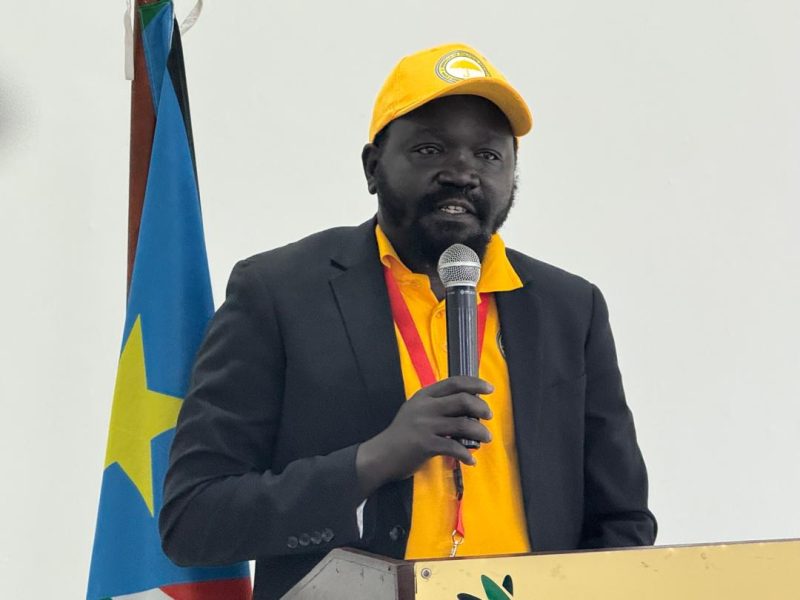
The Umbrella of Political Parties (UOPP) has unveiled a firm strategic roadmap outlining its political demands and conditions for ending South Sudan’s transitional period and delivering democratic elections in December 2026.
The roadmap was adopted at the Juba Strategic Planning Conference held from February 27–28, 2026, at the Grand Hotel in Juba, bringing together members of the National Leadership Council, National Executive, state chairpersons from all ten states and three administrative areas, as well as representatives of the Women’s and Youth Leagues.
In its final communiqué, the UOPP declared its unwavering commitment to participate in and lead the general elections scheduled for December 22, 2026, rejecting any further extension of the transition.
The coalition warned that repeated delays have entrenched political uncertainty, weakened state institutions, and undermined the sovereign will of the South Sudanese people.
“The December 2026 elections are not optional; they are a national mission of rescue,” the communiqué stated, stressing that the current transitional roadmap must culminate in the inauguration of a democratically elected government.
Any provisions of the peace agreement left unimplemented by election day, the UOPP said, must be treated as post-election programs to prevent further delays.
The opposition coalition also laid out a detailed electoral strategy, formally adopting the 102/71/31 seat formula based on the 2010 geographical boundaries, as mandated by the National Elections Commission.
The strategy aims to secure a parliamentary majority through a targeted “91-seat voting block,” combining traditional strongholds with key battleground constituencies.
On governance and security, the UOPP demanded immediate funding for electoral activities, warning that the ongoing liquidity crisis threatens the credibility of the polls.
The coalition announced plans to activate its own Electoral Resilience Fund to support candidates in remote and underserved areas.
The communiqué further called for the immediate completion of transitional security arrangements, the protection of opposition voices, and the creation of safe political space for female candidates.
It also demanded clear mechanisms to guarantee voting rights for internally displaced persons and returnees, particularly in areas affected by boundary adjustments.
League leaders used the conference to reinforce their campaign agendas.
The National Women’s League adopted a platform focused on maternal health, protection against gender-based violence, micro-finance, and primary education, while the National Youth League committed to driving a “digital democracy” campaign and grassroots mobilization across urban centers and cattle camps.
The communiqué was signed on February 28, 2026, by senior UOPP leadership, including Peter Mayen Majongdit, Chairman of the Umbrella of Political Parties, and James Alu Mijak, Action Secretary General.
It was also endorsed by Regina Akuol Bol Mayen, representing the National Women’s League, and Mabior Longar Majok, Chairperson of the National Youth League, alongside state representatives from across the country.
In its closing message, the UOPP presented itself as a non-militarized “third way,” offering South Sudan a democratic alternative to the entrenched status quo.
Declaring unity under the Juba Declaration, the coalition said the “rain of transition” is ending and called for the “sun of democratic transformation” to rise with elections on December 22, 2026.