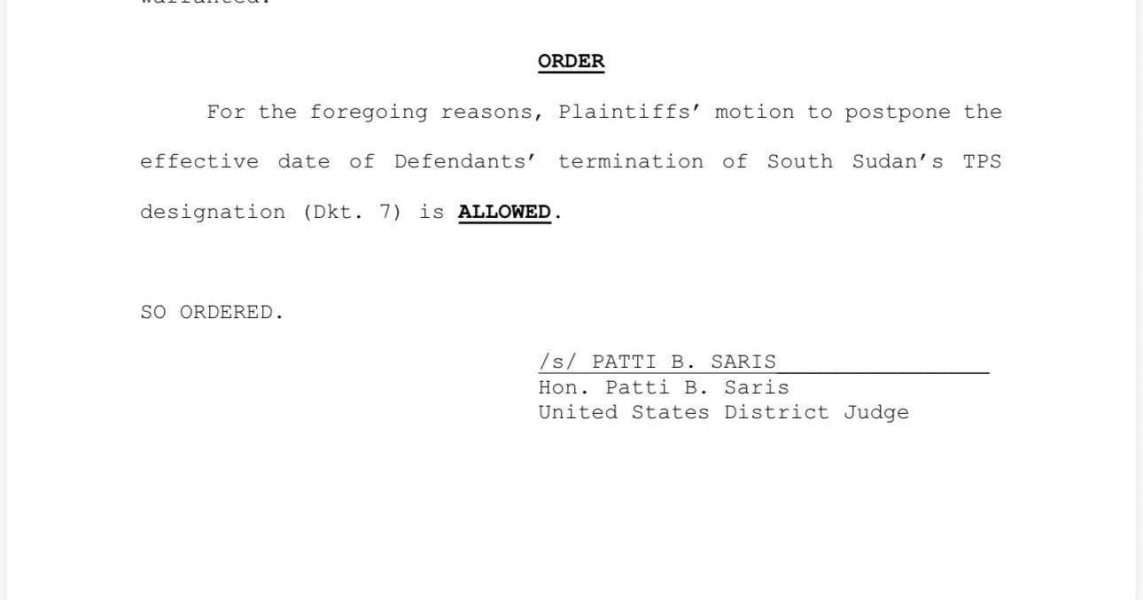

A United States federal judge has ordered a delay in the planned termination of Temporary Protected Status (TPS) for South Sudanese nationals, allowing beneficiaries to retain their legal protections while a court challenge moves forward.
In a signed order, U.S. District Judge Patti B. Saris approved a motion filed by plaintiffs seeking to halt the government’s decision to end South Sudan’s TPS designation.
The ruling means the termination will not take effect on the previously scheduled date.
The court’s decision preserves TPS protections for thousands of South Sudanese nationals currently living and working in the United States, granting them continued protection from deportation and authorization to remain legally in the country until the case is resolved.
Judge Saris found that the plaintiffs had met the threshold required to justify a delay, citing the need to maintain the status quo while the court considers the broader legal and humanitarian implications of ending TPS for South Sudan.
The plaintiffs argue that conditions in South Sudan including ongoing insecurity, political instability, and humanitarian challenges continue to meet the statutory requirements for TPS designation under U.S. law.
They further contend that terminating the program would expose returnees to serious risks.
The U.S. government had announced plans to end South Sudan’s TPS designation as part of a broader review of country-specific protections.
However, the judge’s order temporarily blocks that move, preventing any immediate loss of status for affected individuals.
Under the ruling, TPS beneficiaries from South Sudan may continue to live and work legally in the United States while the lawsuit proceeds.
The court did not set a timeline for a final decision, indicating that further hearings will determine the program’s future.
Advocates welcomed the decision, describing it as a crucial reprieve for South Sudanese families who face uncertainty about their legal status and safety should protections be lifted.
The case now proceeds to substantive review, where the court will assess whether the termination decision complied with U.S. law and adequately considered conditions on the ground in South Sudan.