
A bitter public dispute has erupted over the leadership of Juba’s key markets, with rival chamber officials trading accusations, court orders, and counterclaims in a clash that has left traders caught in the middle.
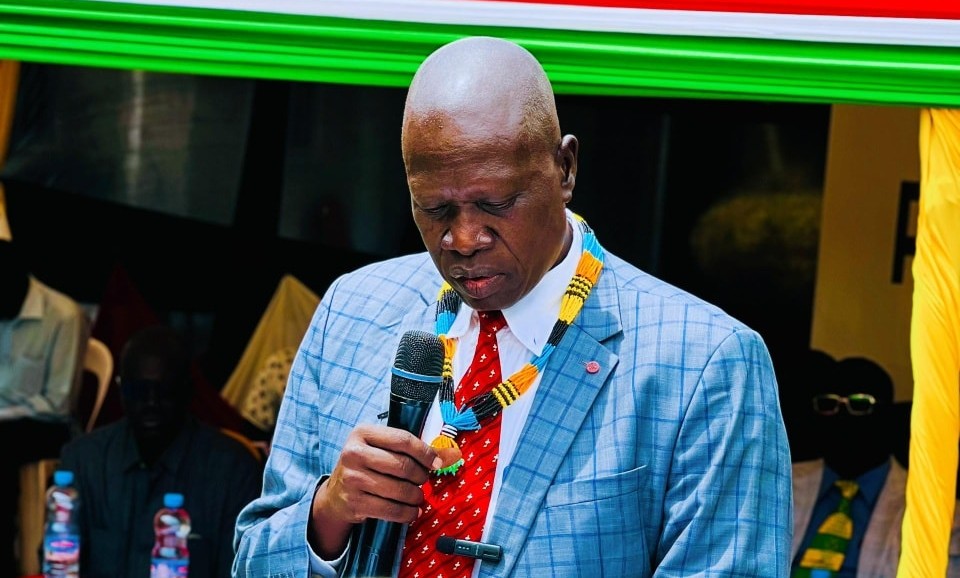
At a press conference on Tuesday, Marcello Swaka Lako, Chairperson of the Juba City Chamber of Commerce, Industry and Agriculture, strongly rejected what he described as politically motivated and baseless allegations against his leadership.
His remarks were in response to a statement issued on February 17 by Robert Pitia Francis, Chairperson of the Central Equatoria State Chamber of Commerce, Industry and Agriculture.
Lako said the leadership of the Juba City Chamber was lawfully reinstated following a final ruling by the Court of Appeal on October 7, 2025, which cancelled Administrative Dissolution Order No. 03/2020 and nullified an election conducted in November 2020.
He added that Juba High Court Order No. 302/2025 formally reinstated his leadership, with the ruling executed on December 23, 2025, allowing market chairpersons to resume office.
“No election should have been conducted while the matter was before the courts,” Lako told journalists, insisting that the appellate ruling was final and binding.
He further dismissed a suspension letter issued against him on February 2, 2026, calling it unlawful and unconstitutional.
According to Lako, the Central Equatoria State Chamber has no legal authority under Article 53 of the SSNCCIA Constitution of 2010 to interfere in the affairs of the Juba City Chamber, which he said operates as an independent body.
On allegations of misconduct and misappropriation of funds, Lako denied any wrongdoing, saying no formal complaint has been filed by members of the Juba City Chamber and that he has never appeared before a recognized disciplinary committee.
He stressed that accountability lies with the Chamber’s General Assembly, not external institutions.
Lako also rejected claims that he was appointed by the Mayor of Juba City Council to advance personal interests, saying his return to office was strictly based on court orders.
He said the mayor’s involvement was limited to maintaining public order after attempts were made to forcefully take over market offices.
However, the Central Equatoria State Chamber has pushed back, rejecting what it described as unlawful political interference in its internal affairs and asserting its independence as a private sector body governed by its own constitution.
Responding separately, Pitia defended the suspension of Lako over alleged misconduct and misappropriation of Chamber funds and assets.
He also raised concerns over what he described as irregular stall allocations at Gudele Central Market and Konyo-Konyo Market, as well as unauthorized revenue collections, with traders allegedly paying between 30,000 and 70,000 South Sudanese pounds monthly without receipts.
Pitia cited a directive from Benjamin Baak Deng, Chief Justice of South Sudan, ordering a stay of execution pending the final determination of an appeal before the Supreme Court, and urged all parties to respect the ongoing court process.
As the legal and political battle intensifies, both leaders have called on authorities to uphold the rule of law and protect traders, warning that continued uncertainty could disrupt market operations across the city.
For traders in Juba’s bustling markets, the question remains unresolved: who ultimately runs the markets and whose authority will prevail.