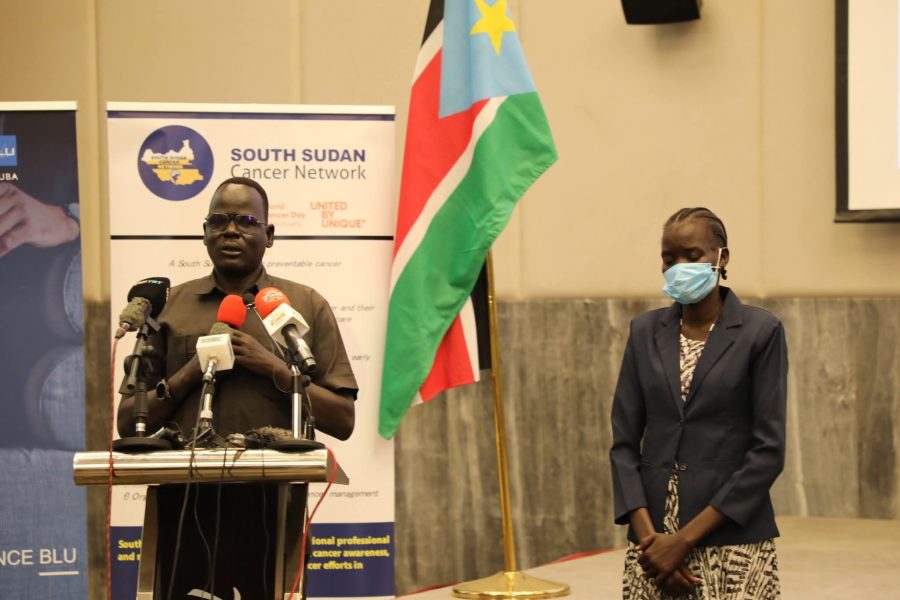
When the floor was hers, 29-year-old Elizabeth Ayen Agot Kuol stood before the microphone to share her cancer story, but the room heard only silence.
Once an energetic woman, Elizabeth is now too weak to speak. Her body is frail. Her movements laboured, and her throat, damaged by cancer, had taken her voice long before it threatened her life.
So, her husband, Bak Goch Bak, stepped forward and spoke on her behalf.
“She was not born like this,” he told a quiet audience of government officials, health experts and diplomats gathered to commemorate World Cancer Day and the official launch of South Sudan Cancer Network (SSCN).
Elizabeth is one of the thousands of faces representing a quiet, deepening health crisis in South Sudan, a crisis defined not just by the biology of the disease, but by the lack of local treatment options that turns manageable diagnosis into a death sentence.
While the country remains consumed by conflict and political uncertainty, families are fighting a different enemy, a silent and costly illness that has begun to cut through households regardless of age, income or status.
Elizabeth’s ordeal began in 2024 after she was diagnosed with throat cancer. With no specialized cancer facility in South Sudan, doctors referred her abroad. The family contributed money, and she was flown to India, where she underwent seven months of chemotherapy and radiotherapy.
The treatment drained their funds. Unable to afford the cost of staying in India, the couple returned to Juba.
It was not long before her condition worsened. She could not eat. The tumour caused a complete blockage in her throat, leaving her unable to swallow anything.
And the external feeding tube attached to her body also developed a problem.
With help from friends and well-wishers, Elizabeth and her husband returned to India for a complex surgery that removed her throat and reconstructed her digestive tract using part of her intestine.
The surgery saved her life, but the aftermath has been unforgiving.
Now back in Juba, Elizabeth suffers from severe pain and a relentless cough. Bak says they have exhausted their funds on travel, hospital bills and immunotherapy drugs, leaving them unable even to afford consistent pain relief.
“I don’t sleep because when I see her, she is crying the whole night,” Bak says, his voice cracking.
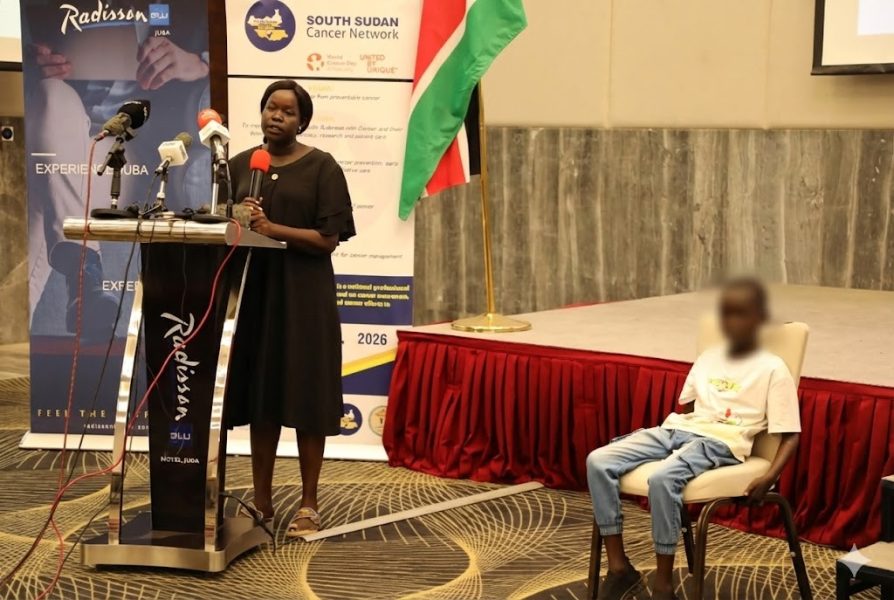
The cancer burden in South Sudan is not confined to adults only. Keji, a single mother, shared the testimony of her 6-year-old son, Ivan. For a month, doctors misdiagnosed his persistent fever as anaemia. It wasn’t until they met Dr. Joseph Gore at Al-Shabah Children’s Hospital that the truth emerged, Acute Myeloid Leukemia (AML), an aggressive cancer of the blood and bone marrow
“If my child is alive today, it’s because of Dr. Gore,” she says.
Like Elizabeth, Ivan could not be treated at home. He was referred to Kampala, Uganda, where he underwent four months of chemotherapy.
Today, Ivan is in remission and has returned to school. But his mother’s relief is shadowed by fear.
Doctors warned her that chances are high the cancer might return, but if it returns, Ivan may require a bone marrow transplant, a treatment that is available in India but financially impossible for many families in South Sudan.
“My worry is that when the disease comes back, what should I do?” she asks. “I do not have the capacity to take my child abroad.”
A growing emergency
Dr. Albino Amum, chairperson of the South Sudan Cancer Network, says the testimonies reflect a national crisis that is growing quietly.
He estimates that South Sudan records more than 6,000 cancer cases annually, with around 5,000 deaths.
Dr. Amum says nearly 80 per cent of patients die because they seek help too late or cannot access treatment.
“The cancer patient, when diagnosed in our facility, either we send them back home to wait for their day because we don’t have a facility… or they go abroad,” he says.
South Sudan currently has no national cancer institute, no radiotherapy services, and few specialists trained in oncology. The country relies instead on a patchwork of visiting specialists. And referrals to Uganda, Kenya and India, a costly route that only a small number of families can afford.
National Minister of Health Sarah Cleto Rial acknowledges the scale of the problem and says the government would begin strengthening cancer response within the health system.
“The Ministry of Health has established a cancer department,” she says, adding that the government has also developed a protocol to assess gaps and guide interventions.
Sarah says the ministry is working toward building systems that can support prevention, early detection and treatment.
“We’re exploring the establishment of cancer treatment facilities, beginning with an oncology department at Juba Teaching Hospital and progressing towards a comprehensive cancer center,” she says.
The World Health Organization Country Representative, Dr. Humphrey Karamagi, warns that South Sudan is undergoing an epidemiological transition, with non-communicable diseases increasingly rising alongside infectious diseases.
“It has for long been a silent crisis in Africa and in South Sudan in particular,” he says. “It is a growing public health and development emergency that demands urgent and sustained action.”
WHO estimates cancer contributes up to 7 percent of all deaths in South Sudan, driven largely by breast and cervical cancer among women, followed by prostate cancer among men.
Dr. Humphreys said one of the most urgent steps is establishing a national cancer registry to understand the true scale of the disease.
“One of our strong recommendations is that we need to set up a national cancer registry so that we can track and understand what is driving our burden of cancer,” he says.
He adds that even when patients are diagnosed, treatment options remain scarce.
“Specialized cancer care, immunotherapy, and radiotherapy are largely unavailable,” he says.
Meanwhile, Central Equatoria State Governor Emmanuel Adil Anthony says the suffering caused by cancer demands action, not speeches.
He pledges that the state government is ready to provide land for the establishment of a cancer institute.
“We have two places… in southern Juba,” he says. “We have a similar one in Yei, which is ready; what is important is our will to fight together.”
Crisis beyond politics
For Bak, the promises of future planning offer some hope, but for his wife, time is not on their side.
He says the government must act urgently because many cancer patients never get the chance to travel abroad, never get chemotherapy, and never even get pain relief.
Instead, they return home and wait.
“It is not good for a country of approximately 13 million people… not to be having any institute that rescues such people,” he says.
As Elizabeth stood silently beside him, her story became the reality of thousands of South Sudanese families, patients whose survival depends not on the health system but on money, connections, and luck.
And for those without any of the three, the diagnosis becomes a sentence. A slow wait, a painful wait and a wait for their day.