
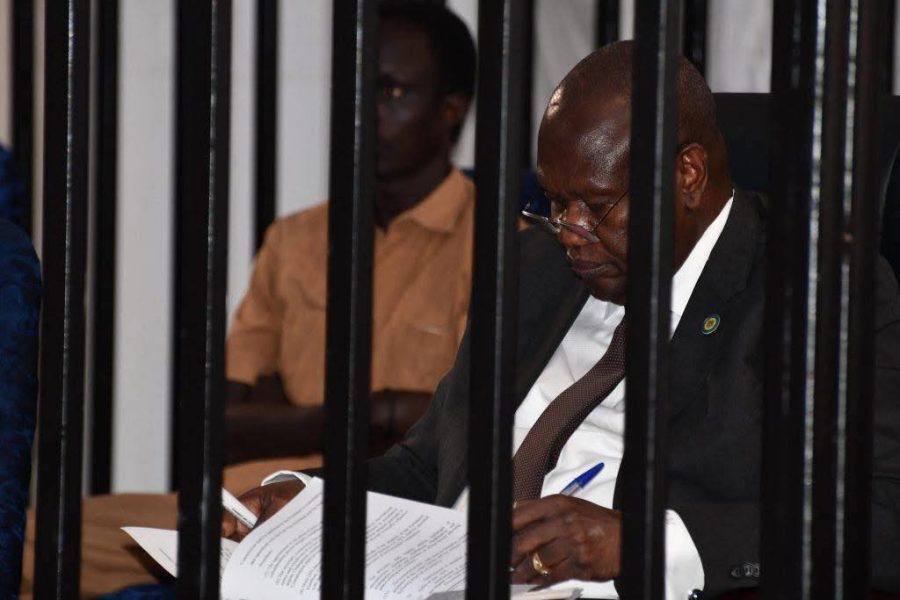
The 67th court session on the Nasir case took a significant turn on Monday after the prosecution’s final witness conceded there was no direct forensic evidence connecting Dr. Riek Machar to the alleged March 2025 attack on SSPDF forces.
The session, held at Freedom Hall, focused heavily on the continued cross-examination of South African digital forensics expert Peter Calvin Rafadi.
The defense challenged the credibility and conclusions of his digital forensic report presented earlier in the trial.
Under questioning, Rafadi acknowledged that his analysis did not uncover any direct orders or communications from Dr. Machar instructing military action. He admitted that no data extracted from the devices examined contained explicit directives related to the alleged attack.
The witness further stated that he was unable to access passwords for some of the devices attributed to the accused, limiting his ability to retrieve complete digital evidence.
As a result, parts of his conclusions were based on inference rather than verifiable forensic data.
Despite this admission, Rafadi maintained that his report pointed to possible command responsibility, arguing that certain indirect communications and call logs suggested coordination among SPLM/A (IO) figures.
However, he conceded that the actual content of those communications could not be verified.
The defense strongly rejected this line of reasoning, arguing that the prosecution’s case lacked direct, concrete evidence and relied heavily on assumptions rather than forensic proof.
They maintained that the testimony failed to establish a clear link between Dr. Machar and the alleged incident.
Attention was also drawn to sections of the report referencing alleged WhatsApp exchanges between other accused individuals.
Rafadi cited messages suggesting discussions about contacting “the Chairman,” but admitted that the subsequent conversations were encrypted and inaccessible.
He further conceded that there was no forensic evidence supporting claims that senior military figures purchased ammunition or issued operational commands connected to the incident.
The presiding judge adjourned the proceedings until Wednesday, April 15, 2026, to allow the continuation of cross-examination as the court moves deeper into the evidentiary phase of the trial.
The case remains one of the most closely watched proceedings, as legal arguments increasingly center on the absence or presence of direct evidence linking the accused to the Nasir incident.