
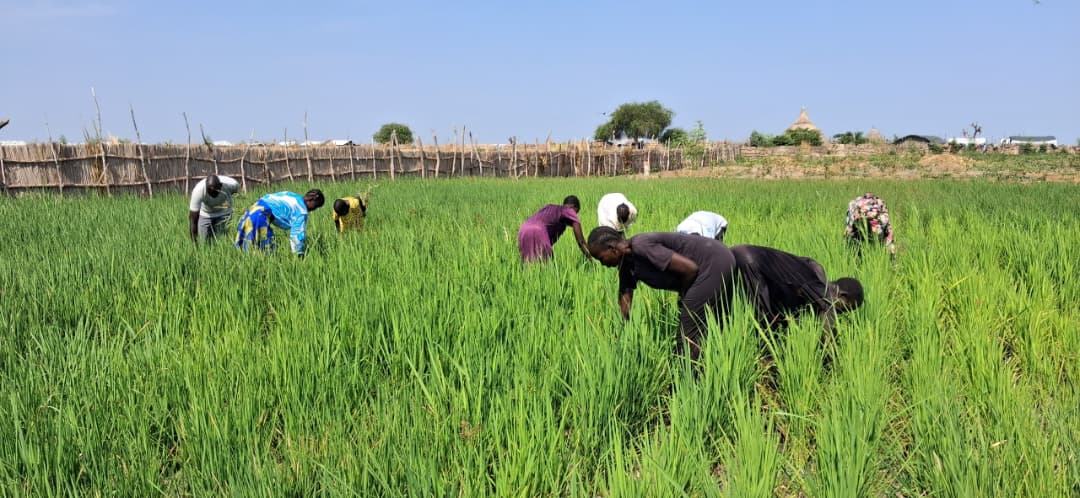
Women in Pakur Boma, Rubkona Payam, are emerging as the driving force behind a major shift toward climate-resilient agriculture, helping communities rebuild livelihoods shattered by years of flooding and conflict.
Across the area, women farmers are adopting new techniques and resilient crop varieties that allow them to survive recurrent floods while boosting household food supplies.
Many of the women involved are widows who depend entirely on farming to support their children, pay school fees, and cover medical needs.
According to Simon Khamis James Yambala, Food Security and Livelihoods Field Manager for Coalition for Humanity (CH), women have shown exceptional leadership in driving the transformation.
“The group is dominated by women. We trained them on climate-smart practices and provided crops that can withstand flooding,” he said, noting their strong commitment to adopting the new methods.
Farmers in Pakur are now cultivating flood-tolerant crops such as rice, sugarcane, yams, and sweet potato vines varieties capable of growing even when water levels rise.
Rice, in particular, has become a priority due to high market demand in Rubkona, providing women with new income opportunities while strengthening local food availability.
Household-level vegetable production has also been encouraged to improve nutrition for children and lactating mothers.
Beyond crop production, communities are integrating environmental conservation into their farming practices, including tree planting, avoiding residue burning, and establishing community woodlots to protect local ecosystems.
Khamis urged the government and donor partners to invest in land reclamation to recover fertile ground lost to years of flooding, saying more arable land is essential for sustaining the gains women farmers are making.
Tapisa Nyankuan, chairlady of the Pakur Farmers Group, appealed for further support to help farmers expand production.
“We are committed to farming, but we need more tools, improved seeds, and irrigation pumps to increase our harvests throughout the dry season,” she said.
Local authorities have praised the women-led efforts, describing them as essential to restoring stability in Rubkona.
“Empowering women farmers is not just about food production it uplifts entire households,” one official noted.
Since January 2024, the broader resilience program has supported women and youth leadership, natural resource management, entrepreneurship, peace dialogues, and access to clean water initiatives implemented by Save the Children, Tearfund, Coalition for Humanity (CH), War Child Holland, and WOCO.
With women at the forefront, Pakur Boma is steadily rebuilding its agricultural foundation and demonstrating how climate-smart farming can strengthen both livelihoods and community recovery.