
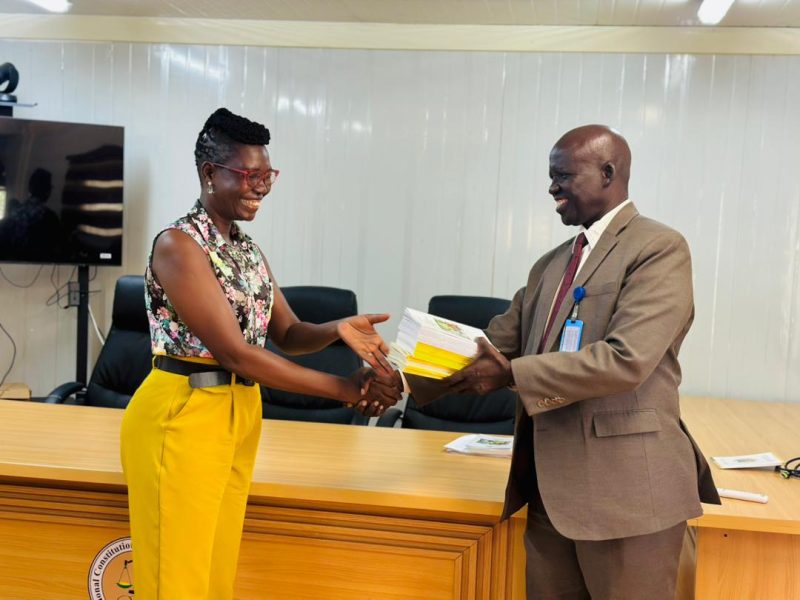
Women’s rights organizations and young female leaders in South Sudan are calling for a gender-sensitive permanent constitution that guarantees equal rights and ensures women have a meaningful voice in shaping the country’s future.
The calls emerged during an engagement between young women activists and officials from the National Constitutional Review Commission (NCRC) and the Referendum Commission in Juba.
The participants discussed their role in the ongoing constitution-making process and highlighted key issues they believe should be reflected in the country’s supreme law.
Keji Viola George, Advocacy Officer at Global Voices, said many women continue to face obstacles in accessing decision-making spaces despite their important contributions to society.
“It is not always easy for young women to be part of national processes. Women, young women, and persons with disabilities are often left behind when important decisions are being made,” George said.
She noted that the initiative seeks to empower young women to participate actively in national affairs and ensure their concerns are incorporated into the final constitution.
“The previous project ended before many of our objectives were fully achieved. Through this initiative, we want young women to continue engaging in important national processes, especially the constitution-making process,” she added.
Before meeting constitutional officials, ten young women underwent a capacity-building training on constitutional governance and civic participation.
Organizers said the training equipped participants with knowledge about constitutional principles and prepared them to engage constructively with policymakers.
During the discussions, participants raised concerns about the implementation of the 35 percent affirmative action provision for women, a commitment contained in South Sudan’s peace agreements that activists say remains inadequately enforced across many institutions.
The participants also highlighted the absence of a clearly defined minimum marriage age in constitutional discussions, arguing that stronger legal safeguards are needed to protect girls from early and forced marriage.
“We identified gaps, particularly around the marriageable age and the implementation of the 35 percent affirmative action. We are encouraged that these concerns were acknowledged, and we hope they will be reflected in the final constitution,” George said.
Officials from the National Constitutional Review Commission acknowledged the concerns and assured participants that the views of women, youth, and persons with disabilities would continue to be considered during civic education campaigns, public consultations, and the drafting of the permanent constitution.
Addressing the gathering, John Nathan Abraham of the commission described the constitution-making process as a historic opportunity for South Sudanese citizens to determine the future direction of their country.
“When international organizations speak about the constitution-making process, it may sound like a technical exercise. But for us as South Sudanese, it represents our history, our struggles, and our aspirations as a people,” Abraham said.
He said the constitution should reflect the aspirations, sacrifices, and achievements of South Sudanese citizens while protecting the social, political, and economic gains secured through decades of struggle.
“Our people fought for dignity, justice, equality, and a better quality of life. Those aspirations must be reflected and safeguarded in the Constitution,” he said.
Abraham emphasized that rights become legally enforceable when they are enshrined in the constitution, enabling citizens to seek legal remedies whenever those rights are violated.
He also urged the young women to serve as ambassadors of constitutional awareness within their communities and encourage broader public participation in the process.
“Meaningful change is not always driven by large crowds. Nations are often transformed by a small group of dedicated and committed individuals who understand a vision and work tirelessly to achieve it,” he said.
Women’s organizations involved in the initiative say they plan to expand constitutional awareness campaigns beyond Juba through their networks in other parts of the country, including Torit and Kuajok. The aim is to ensure communities understand the significance of the constitution and have an opportunity to contribute to its development.
The dialogue was organized by Global Voices under its Justice for Her and Legal Reform Project, supported by Equality Now. The initiative seeks to empower young women to actively engage in national decision-making processes and contribute to shaping South Sudan’s future legal framework.
Advocates say the permanent constitution presents a rare opportunity to address long-standing inequalities and establish stronger safeguards for women, youth, and persons with disabilities.
As South Sudan moves closer to adopting a permanent constitution, civil society groups argue that meaningful public participation will be critical to producing a document that reflects the aspirations of all citizens.
They say a gender-sensitive constitution that safeguards equality, representation, and human rights could play a vital role in promoting democratic governance, social justice, and lasting peace in the world’s youngest nation.