
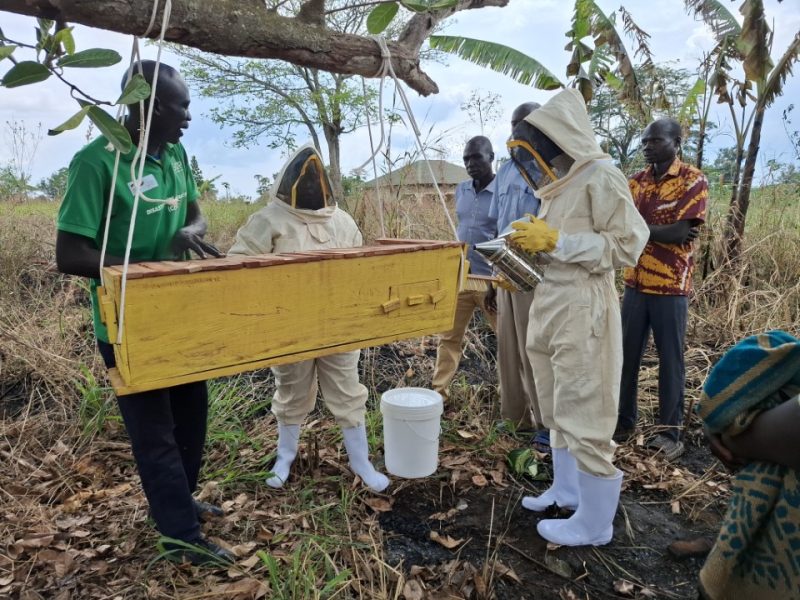
Communities in Yei River and Magwi counties are increasingly turning to honey production as a reliable source of income, following a new initiative aimed at strengthening rural livelihoods and building economic resilience across parts of Central and Eastern Equatoria.
A total of 140 beneficiaries, including 105 men and 35 women, have received 280 modern Kenya Top Bar beehives, alongside intensive hands-on training in apiculture.
The training covered key areas such as hive management, pest control, honey harvesting, and post-harvest handling, enabling participants to significantly improve both the quality and quantity of their honey production.
The program also places strong emphasis on commercialization.
Through a partnership with Hagana Agro Processing, beneficiaries are being connected to a more reliable market for their honey addressing a long-standing bottleneck that has limited profitability in the sector.
For many rural households, beekeeping is emerging as a strategic alternative to rain-fed agriculture, which remains highly vulnerable to erratic weather patterns and climate shocks.
Analysts say diversification into apiculture can help communities reduce risk while maintaining a steady income stream throughout the year.
Speaking at the conclusion of the training, Julius Lotare, Boma Chief of Labato, said the initiative marks a turning point for local farmers who have long relied on traditional methods with limited returns.
“We are now better positioned to transition from traditional to modern beekeeping,” he said, urging participants to remain committed and work collectively to build a sustainable honey industry in their communities.
Beneficiaries echoed similar optimism, noting that traditional hives previously produced low yields and inconsistent quality.
With improved techniques and equipment, many now expect higher production volumes and better prices in the market.
Beyond technical support, the project will continue to provide follow-up coaching in business planning, financial management, and marketing.
This is intended to help farmers move beyond production and establish small-scale enterprises capable of competing in local and regional markets.
The initiative is funded by German Development Cooperation, the European Union, and the Embassy of the Kingdom of the Netherlands, reflecting a coordinated international effort to promote inclusive economic growth in South Sudan.
Development experts say such interventions are critical in a country where the majority of the population depends on agriculture for survival but continues to face structural challenges, including limited infrastructure, weak market systems, and climate-related disruptions.
By strengthening the honey value chain from production to processing and marketing the project is not only increasing household incomes but also encouraging environmental conservation through sustainable land use practices.
The effort, led by the Deutsche Gesellschaft für Internationale Zusammenarbeit (GIZ) under its Community-Driven Rural Development (CDRD) project, is equipping local farmers with modern beekeeping skills, tools, and market linkages helping shift the sector from subsistence activity to a structured, income-generating enterprise.
As communities in Yei and Magwi embrace modern beekeeping, the sector is steadily gaining recognition as a viable pathway to long-term economic stability.