
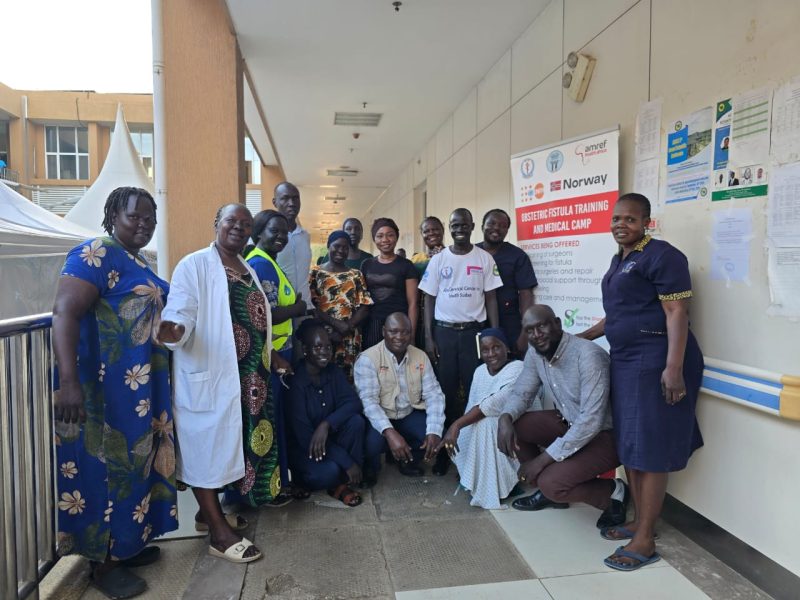
Fifty-eight women have undergone surgery to repair obstetric fistula in Juba, offering relief to patients who say the condition had kept them isolated from their communities and daily lives.
The women received treatment during a specialised fistula repair camp held from 25 August to 7 September.
Among them was Christine, 40, from Kapoeta, who said the condition had restricted her ability to move freely and participate in community life.
“I was tired of living with this condition. For a long time, I could not go anywhere in my community. I am now happy and excited about the future,” she said.
Another patient, Viola, 20, also from Kapoeta, expressed gratitude to the medical teams and organisations involved in helping women travel to Juba for treatment.
Obstetric fistula is a serious childbirth-related injury, often caused by prolonged or obstructed labour. It can result in continuous leakage of urine or faeces and, in some cases, lead to stigma, social isolation and difficulties earning a living.
Treatment beyond the camp
The latest surgeries add to 21 routine fistula repairs carried out at Juba Teaching Hospital between July and August, according to figures presented during the programme.
Health officials say routine fistula services are expected to continue at the hospital through the end of the year.
Dr Lado Wani Ismail, who led the recent repair camp, said the end of the specialised programme should not be seen as the end of treatment services.
“The camp may be over, but the routine fistula services will continue,” Dr Wani said.
The camp involved medical teams from the Ministry of Health and Juba Teaching Hospital, alongside Amref Health Africa and other organisations.
Speaking on behalf of Amref Health Africa, Taban Patrick said collaboration between government institutions, health facilities and partners had helped expand access to specialised treatment.
He said the wider programme aims to carry out 300 fistula repairs by the end of 2026. So far, about 70 cases have been repaired, according to figures presented during the programme.
Patrick also called for stronger systems at community level to identify women living with fistula and refer them for treatment.
Wider access remains a challenge
Despite the number of women treated in Juba, health workers say reaching patients who remain in remote communities is still a major challenge.
Some women can live with fistula for years without receiving treatment because of limited awareness, distance from health facilities, financial constraints and the stigma associated with the condition.
Akech, the Ministry of Health’s coordinator for fistula patients, said fistula repair should increasingly become part of routine surgical services rather than depending primarily on specialised camps.
He said having a fistula surgeon stationed at Juba Teaching Hospital was an important step for women requiring treatment.
Routine services, he added, could complement specialised campaigns conducted in different parts of the country.
The need for stronger referral networks is particularly important in a country where many communities remain far from specialised medical services.
For women such as Christine, however, surgery represents more than a medical procedure.
After years of restricting her movements and affecting her participation in community life, she says she is now looking forward to returning to a more normal routine.
“I am now happy and excited about the future,” she said.