
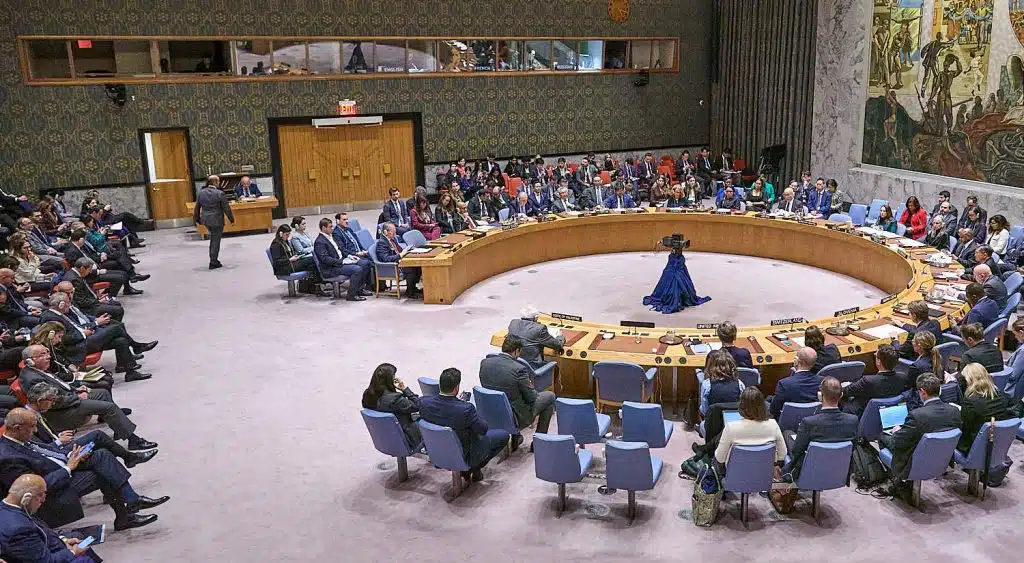
The Reconstituted Joint Monitoring and Evaluation Commission (RJMEC) has warned the UN Security Council that South Sudan’s revitalised peace agreement is at growing risk of collapse due to a prolonged political and security deadlock, repeated ceasefire violations and slow implementation of key provisions.
Delivering a virtual briefing to the Security Council on Wednesday, RJMEC Interim Chairperson Ambassador Maj. Gen. George Aggrey Owinow (rtd) said implementation of the 2018 Revitalised Agreement on the Resolution of the Conflict in the Republic of South Sudan (R-ARCSS) has been “significantly constrained” by a political and security impasse that has persisted since March 2025.
He said the stalemate, marked by diminished political inclusivity, unilateral removals and replacements of officials, repeated violations of the permanent ceasefire and disruptions to key implementation mechanisms, has weakened trust among the peace partners and slowed implementation of governance and security reforms.
“Overall, progress has been significantly constrained by the persistent political and security impasse that has endured since March 2025,” Owinow told the Council.
The briefing, based on RJMEC’s quarterly report covering the period from April to June 2026, comes less than five months before South Sudan’s scheduled general elections on 22 December.
While acknowledging some progress, including the launch of nationwide civic and voter education campaigns and the registration of 39 political parties, RJMEC said the country remains far from meeting the conditions required for peaceful, credible and inclusive elections.
According to the commission, several critical prerequisites remain unresolved, including political consensus among the parties, completion of the unification of forces, security sector reforms, adequate funding for electoral institutions, guarantees for civic and political freedoms and improvements in security across conflict-affected areas.
RJMEC also expressed concern over recent amendments to key provisions of the peace agreement by the Revitalised Transitional Government of National Unity, saying the changes were made without following the procedures required under the agreement.
The amendments seek to separate the permanent constitution-making process and the national population census from the planned December elections.
The commission warned that continued insecurity remains one of the biggest threats to the transition.
Clashes involving the South Sudan People’s Defence Forces (SSPDF), the Sudan People’s Liberation Army-in-Opposition (SPLA-IO) and armed groups continue to be reported in parts of Upper Nile, Jonglei, Unity and Equatoria regions.
It noted that implementation of the permanent ceasefire remains partial and inconsistent, while Phase II of the Necessary Unified Forces, broader security sector reforms and the Disarmament, Demobilisation and Reintegration (DDR) programme have largely stalled.
Beyond the security situation, RJMEC said the humanitarian crisis continues to worsen because of renewed violence, displacement, food insecurity, restrictions on humanitarian access and inadequate public services.
These challenges, it said, are limiting the participation of women, young people and persons with disabilities in political and civic processes.
The commission also highlighted slow progress in implementing gender provisions of the peace agreement, noting that women’s representation in public institutions remains below the mandatory 35 percent threshold.
Despite the setbacks, RJMEC acknowledged improvements in public financial management and economic governance, including oil production remaining above 170,000 barrels per day and efforts to strengthen transparency in oil revenue management.
The commission further welcomed progress in the permanent constitution-making process, saying the National Constitutional Review Commission has completed civic education and public consultations across all ten states and the three administrative areas.
To help prevent further deterioration of the peace process, RJMEC urged the Security Council to continue supporting full implementation of the peace agreement and to work closely with the African Union, IGAD and regional partners to facilitate an inclusive political dialogue among South Sudanese stakeholders.
It also called on all parties to de-escalate tensions, cease hostilities, release political detainees, including First Vice President Dr. Riek Machar, and recommit themselves to implementing the peace agreement in both letter and spirit.
In addition, RJMEC appealed for increased political, technical and financial support for key electoral institutions, including the National Elections Commission, the Political Parties Council and the National Constitutional Review Commission, to help them complete preparations before the end of the transitional period.
Concluding the briefing, Owinow warned that failure to resolve the current political impasse could have serious consequences for both South Sudan and the wider region.
He urged the Security Council to consider dispatching a solidarity mission to Juba to engage directly with the parties and support efforts to steer the country towards a peaceful and democratic conclusion of the transitional period.
“RJMEC remains concerned about the danger posed to regional and international peace with a potential collapse of the R-ARCSS and a relapse to violence in South Sudan if urgent, firm and decisive steps are not taken,” he said.