
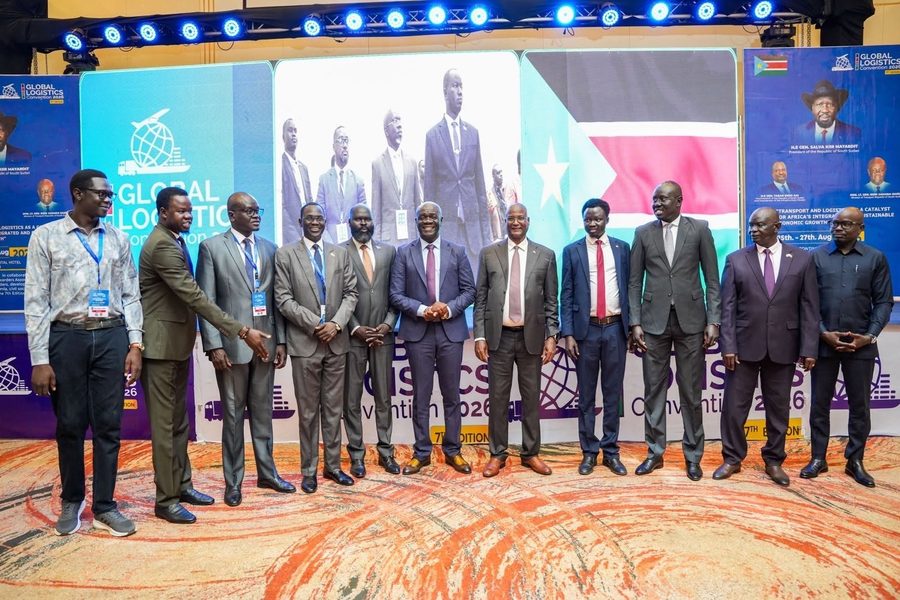
A three-day Global Logistics Convention in Juba has adopted a series of resolutions aimed at reducing trade barriers, improving transport infrastructure and accelerating digitalisation in South Sudan’s logistics sector.
The convention brought together logistics and transport experts from across Africa and beyond, alongside government officials, policymakers, private-sector representatives and industry leaders to discuss challenges affecting trade and the movement of goods.
Deng Daniel, President of the South Sudan Freight and Forwarders Association (SSFFA), said the convention had provided an opportunity to move from identifying challenges to developing practical solutions for the country’s logistics sector.
“We have moved beyond discussions to identify practical solutions that can improve the movement of goods and strengthen South Sudan’s position as a regional trade corridor,” Daniel said.
He said the resolutions adopted at the convention were intended to address some of the major bottlenecks facing traders, transporters and freight forwarders.
One of the key recommendations was the full implementation of a national digital single-window system to streamline customs and clearance procedures, reduce paperwork and human interaction at border points, and lower the time and cost of clearing goods.
Participants also called for the reduction of roadblocks and other non-tariff barriers, better coordination among government agencies at border crossings, and faster implementation of trade and transit reforms.
Daniel urged the government to prioritise investment in roads, energy, multimodal transport infrastructure and digital systems, saying efficient logistics were critical to expanding trade and attracting investment.
“Efficient logistics are essential if South Sudan is to expand trade, attract investment and connect effectively to regional markets,” he said.
The convention also recommended establishing a national logistics training academy to equip young South Sudanese with professional skills and strengthen capacity within the sector.
Daniel said the private sector was ready to work with the government to implement the recommendations, but stressed that the resolutions needed to translate into concrete action.
“The private sector is ready to work with government, but what matters now is turning these resolutions into action,” Daniel said.
He also called for greater use of digital technologies in cargo tracking, freight management, customs clearance and customer services.
Government Response
Transport Minister Razigi Zakariah welcomed the resolutions, saying the government had used the convention to share its priorities, concerns and challenges with regional and international partners.
“We have shared with them what we are doing at our various capacities, as well as our concerns, challenges and priorities, and what we are expecting from our hosts,” Zakariah said.
The minister thanked the organisers and participants for the recommendations and official documents presented to the government, pledging that his ministry would work to implement measures within its mandate.
“We are more than happy and committed to do what we can in order to implement them,” he said.
Zakariah also referred to his keynote address at the opening of the convention, where he outlined ongoing legislative work in the transport sector.
He identified road safety as one of the key priorities, alongside legislation governing the investigation and management of transport-related incidents.
“We are trying as much as we can,” Zakariah said, acknowledging the challenges facing South Sudan in developing its transport sector.
He said some immediate issues could be addressed through ministerial or provisional orders, while matters beyond the ministry’s authority would require consideration by the Council of Ministers.
Zakariah said the government remained open to further discussions with stakeholders and reaffirmed its commitment to working towards the implementation of the convention’s recommendations.
The resolutions are expected to provide a framework for strengthening South Sudan’s transport and logistics sector, reducing the cost of moving goods and improving the country’s integration into regional trade networks.