
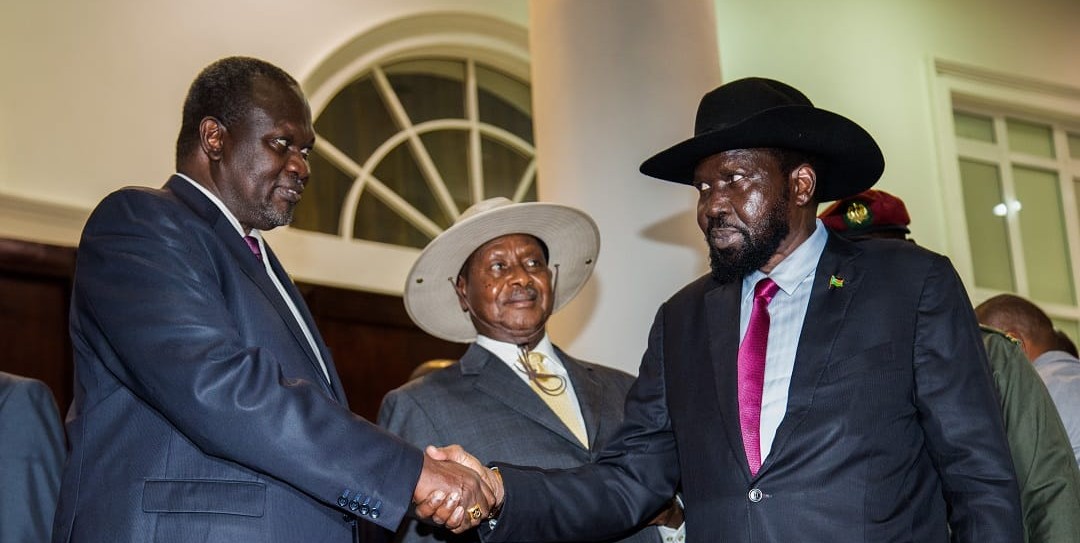
President Salva Kiir Mayardit has removed First Vice President Riek Machar Teny and the country’s four other vice presidents as part of the dissolution of South Sudan’s transitional government ahead of elections scheduled for 22 December 2026.
The move affects all five vice-presidential positions created under the country’s power-sharing arrangement, including Dr James Wani Igga, Hussein Abdelbagi Akol, Taban Deng Gai and Rebecca Nyandeng De Mabior.
Machar, who leads the Sudan People’s Liberation Movement in Opposition (SPLM-IO), had served as First Vice President under the transitional government formed in February 2020.
The changes follow amendments to the National Elections Act signed by President Kiir after parliament approved them.
The amended law provides for the incumbent president to remain in office with constitutional powers during the election period until a newly elected president assumes office, while requiring the first vice president and other vice presidents to leave office within three months of the election date.
Kiir announced the dissolution of the transitional government on Tuesday, as the country moves into the final months before the planned elections.
The government was established under the Revitalised Agreement on the Resolution of the Conflict in South Sudan (R-ARCSS), signed in 2018 after years of civil war between forces aligned with Kiir and Machar.
The 2018 agreement was intended to end South Sudan’s conflict and establish a power-sharing government. Under the deal, Kiir remained president while Machar returned as First Vice President, alongside four other vice presidents.
The arrangement was formally implemented in February 2020 when the Revitalised Transitional Government of National Unity was formed.
The agreement also provided for reforms including security-sector arrangements, constitutional reforms and elections.
However, implementation of several key provisions has been repeatedly delayed, while political disagreements between the parties have continued.
Machar was suspended as First Vice President in 2025 and has since been facing trial in Juba over his alleged role in violence in Nasir, Upper Nile State. He denies the charges. His trial is continuing, with the latest sitting adjourned until 23 September over a defence application concerning security concerns.
The removal of the five vice presidents now marks the end of the power-sharing presidency established under the transitional arrangement.
The December election is intended to be South Sudan’s first national election since independence in 2011. The vote has been postponed several times during the country’s transitional period.
The latest changes have also drawn debate over the future of the 2018 peace agreement and the concentration of executive authority during the election period.
The South Sudan Opposition Alliance has rejected the recent electoral-law changes, saying they were made without adequate consultation among the parties to the peace agreement.
