
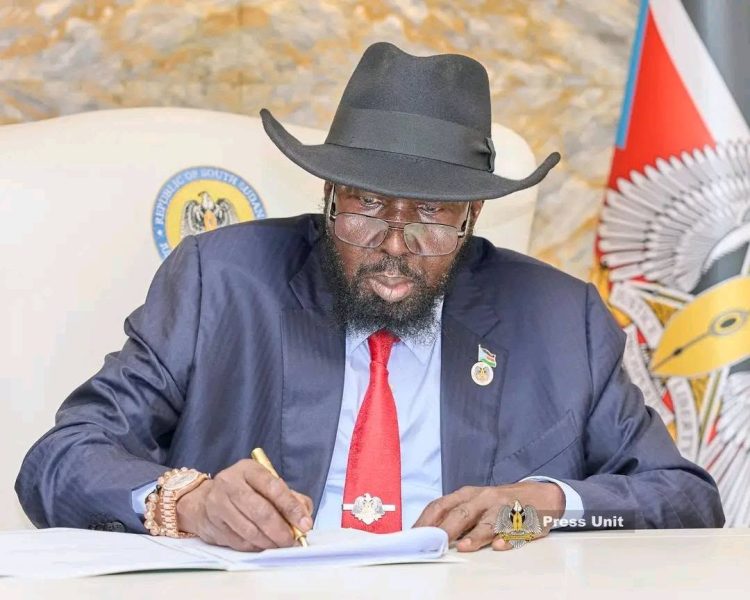
President Salva Kiir Mayardit has signed South Sudan’s amended elections law into force, hours after lawmakers passed it, setting out a new legal framework for the country’s scheduled December 2026 elections.
The National Legislature passed the National Elections Act, 2012 (Amendment) Bill, 2026, on Monday before it was sent to President Kiir for assent. The president signed the legislation later the same day.
The amended law allows the incumbent president to remain in office and exercise his constitutional powers during the election period until a newly elected president assumes office.
It also provides for the First Vice President and other vice presidents to leave office within three months before the election date, while the national legislature, state assemblies and state governments are to be dissolved within the same period under the new electoral arrangements.
Parliamentary spokesperson Oliver Mori Benjamin said the legislation contains two chapters and 17 sections covering issues related to the executive, elections and the composition of the next parliament.
Mori said the bill was intended to provide a legal framework for the transition from the current transitional institutions to elected bodies.
Earlier, while explaining the bill to journalists, Mori said it provided for the incumbent president to remain in office with constitutional powers throughout the election period.
The law also separates the conduct of elections from the permanent constitution-making process and the national population and housing census, allowing the National Elections Commission to proceed with preparations without waiting for those processes to be completed.
The amendment followed growing efforts by the transitional government to prepare for elections scheduled for 22 December 2026.
The National Elections Act, 2012 was originally enacted to provide the legal framework for elections in South Sudan. It was later amended in 2023, but the government argued that further changes were necessary to address inconsistencies and bring the legislation into line with the Transitional Constitution.
Justice and Constitutional Affairs Minister Wek Mamer Kuol formally tabled the 2026 amendment bill before Parliament on September 16 for its first reading.
When presenting the bill, Mamer said its purpose was to harmonise inconsistencies in the 2012 elections law and ensure that it conforms with the Transitional Constitution of 2011, as amended.
The Council of Ministers had approved the proposed amendments earlier in September as preparations for the December elections intensified.
Among the proposed changes were provisions separating elections from the completion of the population census and changes to the composition of the next elected parliament.
The bill subsequently went through parliamentary consideration before lawmakers passed it on September 21.
Parliament’s state broadcaster, SSBC, reported that the bill was endorsed with observations and recommendations before being forwarded to the president for assent.
The legislation also sets the National Legislative Assembly at 270 members, while state legislative assemblies will have 58 members each and administrative-area councils 20 members each, according to the enacted law reported by SSBC.
The amendment comes after South Sudan’s transitional period, established under the 2018 peace agreement, was repeatedly extended without the country holding the elections originally envisaged at the end of the transition.
The December 22 election is now scheduled to take place as the country moves toward the end of the current transitional arrangements.
With September 22 marking three months before the scheduled polling date, the amended law comes into force at a significant point in the electoral timetable.
The National Elections Commission is expected to continue preparations for the December polls under the new legal framework.