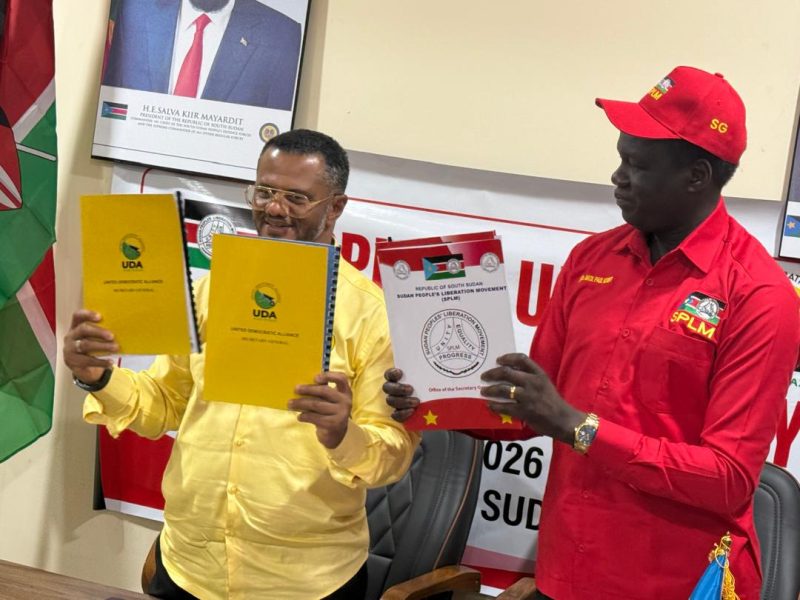
South Sudan’s ruling Sudan People’s Liberation Movement (SPLM) and Kenya’s United Democratic Alliance (UDA) have signed a five-year Memorandum of Understanding (MoU) to strengthen cooperation in leadership development, policy exchange, party building, regional integration and peace efforts.
Speaking after the signing, SPLM Secretary-General Dr. Akol Paul Kordit and UDA Secretary-General Sen. Hassan Omar Hassan said the agreement establishes a framework for long-term collaboration while allowing both parties to amend it as circumstances evolve.
Dr. Akol said the memorandum is based on a standard framework commonly used by like-minded political parties to define areas of cooperation.
“The length is five years, but there is a provision that at any time the two parties can review and amend the MoU. It is flexible and open to new progressive ideas that may arise,” he said.
According to Dr. Akol, the agreement focuses on leadership training, institutional development, youth and women empowerment, exchange programmes, and evidence-based policy research. He added that it is guided by the principles of the African Union and regional bodies including the East African Community (EAC).
He dismissed suggestions that either party could dominate the other, saying the partnership was designed to be mutually beneficial.
“The MoU is not meant to transform one party to be like the other. It is meant to help the two parties grow mutually, learn from each other and cooperate in areas of common interest,” he said.
Dr. Akol said SPLM hopes to benefit from Kenya’s governance experience, while UDA could also learn from SPLM’s history as a liberation movement.
He added that the agreement could contribute to South Sudan’s peace efforts by allowing the SPLM to draw lessons from Kenya’s political development, including its experience in resolving post-election violence.
“Kenya has been helping South Sudan for many years. It played a key role during our liberation struggle and continues to support peace efforts through IGAD. There is a lot we can learn from Kenya as we prepare for our own elections,” he said.
Dr. Akol described Kenya as one of the region’s strongest economies with valuable experience in governance, economic development and public institutions that South Sudan could adapt as it continues rebuilding after years of conflict.
He also said the agreement was deliberately drafted with enough flexibility to remain relevant as political and technological changes continue to reshape governance.
“The world changes very fast. Political parties have to realign themselves with those changes; otherwise, they become outdated. That is why we included provisions allowing either party to propose amendments whenever necessary,” he said.
For his part, UDA Secretary-General Sen. Hassan Omar Hassan said the partnership extends beyond political cooperation and reflects a broader vision of African integration.
“If it were up to me, there would be no borders. I personally believe in the integration process of the African continent so that we can collectively address our shared challenges,” he said.
Hassan said Kenya also has much to learn from South Sudan, particularly from the SPLM’s liberation history and nation-building experience.
“Kenya has a lot to learn from SPLM and the people of South Sudan. The history of liberation and emancipation provides valuable lessons on building a nation after conflict and colonialism,” he said.
He stressed that the memorandum establishes an equal partnership.
“This memorandum is mutually beneficial to both of us. There is no bigger brother or sister. We are entering this partnership as equals,” Hassan said.
The UDA official also expressed hope that African countries would one day achieve deeper political and economic integration, describing it as a long-term aspiration for the continent.
Closing the briefing, Dr. Akol echoed that vision, recalling former Libyan leader Muammar Gaddafi’s proposal for a “United States of Africa.”
He said genuine continental integration would require African countries first to overcome tribal divisions and strengthen national unity before building broader African values.
He added that while border issues remain between neighbouring states, such disputes should continue to be addressed through regional and international mechanisms, with deeper integration ultimately driven by the people rather than governments.
The two parties said the full text of the memorandum will be made public.