Upper Nile State’s Council of Ministers has approved a series of administrative reforms, including a sharp reduction in the number of technical advisers and an order directing cabinet ministers currently in Juba to return immediately to Malakal.
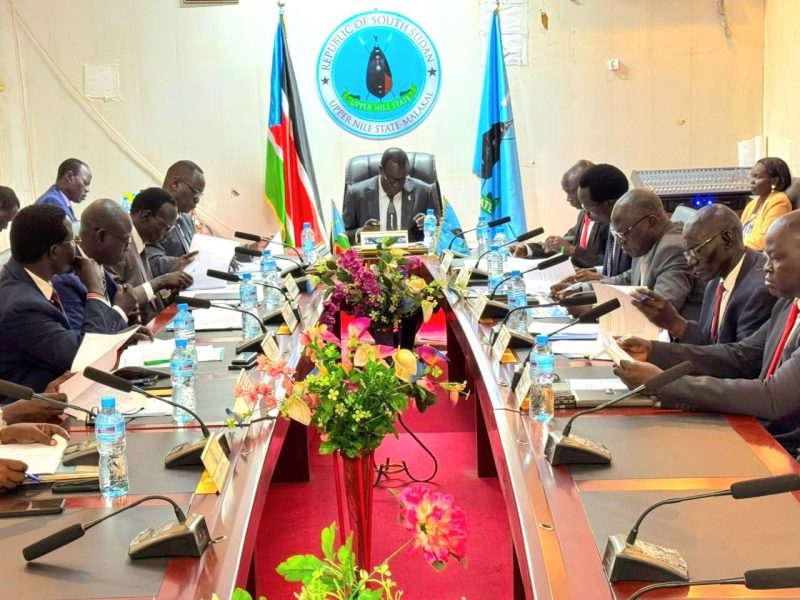
The decisions were adopted during the Council of Ministers’ first regular sitting of 2026, chaired by Governor Lt. Gen. James Koang Chuol Ranley in the state capital on Thursday.
According to a statement issued by the Office of the Governor, the cabinet reviewed key resolutions carried over from 2025 before unanimously endorsing them.
Among the most significant decisions was the reduction of technical adviser positions from 17 to seven, cutting the number of advisers by more than half.
The statement did not explain the reason behind the reduction, but the move is expected to streamline the state administration as the government implements its priorities for 2026.
The cabinet also approved a proposal to redesign the Upper Nile State logo.
Ministers further endorsed the state’s 2026 Development Agenda, which is expected to guide government programmes and policy implementation during the year.
No details were immediately released on the agenda’s specific priorities or the proposed changes to the state emblem.
In a separate directive, Governor Koang ordered all cabinet ministers who are currently in Juba to report back to Malakal “with immediate effect.”
The governor’s office did not state why several ministers remained in the national capital or provide a timeline beyond the immediate return order.
The directive signals the governor’s intention to have his administration fully operational in Malakal as the state moves to implement the newly approved reforms and development programme.
The meeting marked the first regular cabinet sitting since Governor Koang assumed office after his reappointment by President Salva Kiir earlier this year.
It also underscored the administration’s focus on restructuring government institutions and strengthening coordination from the state capital.
The meeting was attended by members of the Upper Nile State Council of Ministers, who unanimously adopted all resolutions presented during the session, according to the governor’s office.
No further announcements were made regarding the implementation timeline for the adviser reductions or the return of ministers from Juba.