
When Gemeiza Kakule Kwajok sat her Senior Four examinations in 2021, she knew exactly what she wanted next: university.
What she did not know was how she would get there.
Her family had little money. Her father had supported her education from primary school through secondary school, but by the time her results were released, years of cattle raids had left the family with too few animals to finance another child’s education.
“I called my father in the village and told him that the results were out, that I had performed well, and that I wanted to go to university,” Gemeiza recalls.
Her father was proud. But he could not pay.
“He thanked God, but explained that he could not afford to sponsor me because our cattle had been raided several times,” she says.
He told her the remaining cattle were needed to support her younger siblings and the family’s mothers.
For Gemeiza, the news was devastating.
“I was heartbroken and cried for days because my father was the only person supporting me financially.”
But crying was not going to get her to university. So she began searching.
And she would spend months searching for a way forward.
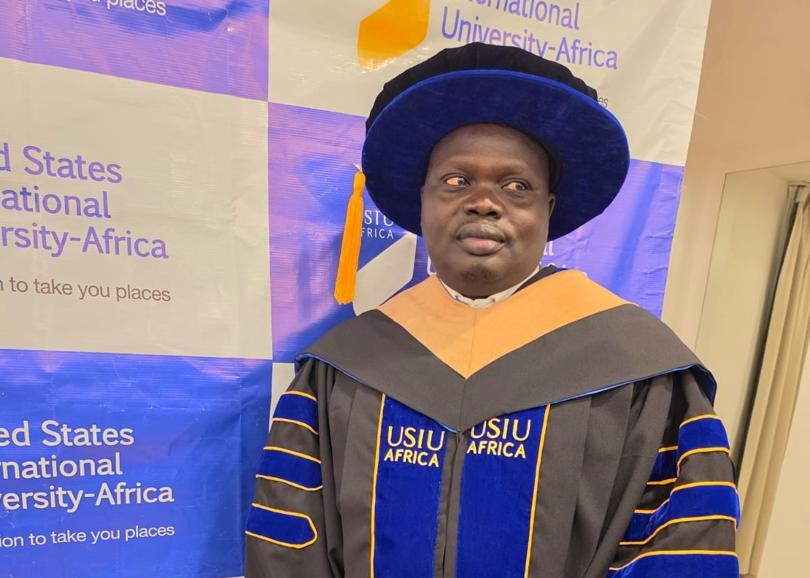
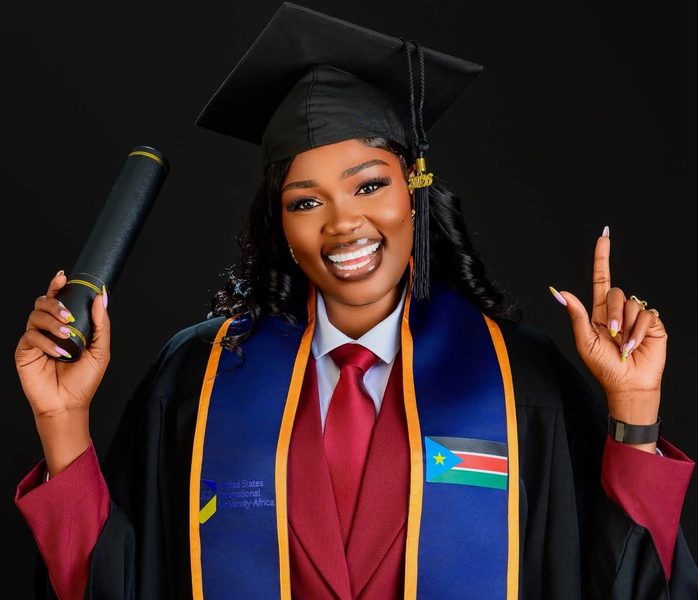
Today, September 26, 2026, that search has ended at a graduation ceremony in Nairobi, where Gemeiza is celebrating a degree in Cybersecurity from the United States International University Africa (USIU-Africa), School of Computer Science and Information Systems.
Her journey from selling water in Juba to graduating in Kenya is one she describes as a story of faith, determination and an opportunity that came when she had almost lost hope.
From selling water to searching for university
Gemeiza’s struggle began before her university dream was secured.
In March 2021, after completing her Senior Four examinations while staying with relatives, she was taken by a friend and her sister to Fulla Company in Konyo Konyo, where she began selling water to earn money and support herself.
She worked alongside boys in the Sales and Marketing Department, moving around Juba from morning until evening.
“We moved around Juba from morning until evening, selling water as Atalas,” she recalls.
For a young girl who had just completed secondary school, it was difficult work.
But it gave her something she needed: a way to survive while waiting for her next opportunity.
After several months, she travelled back to Gemeiza Payam to visit her parents and siblings.
There, an unexpected encounter would plant the first seed of her university dream.
While walking with her cousin Poni towards the riverside to buy fresh tilapia, the two girls encountered a large group of soldiers working on a road project.
They became frightened and took a bushy route. Then General Gabriel Lubang called out to them.
“Kakule, don’t be afraid. You girls can come to the main road. These soldiers will not harm you.”
The encounter led to a conversation about education.
Simon Akuei Deng asked their names, while Dr Benjamin Bol Mel asked Gemeiza whether she was still in school.
She explained that she had completed Senior Four and was waiting for her results.
Then came a question that stayed with her.
He asked whether she wanted to continue to university if she performed well.
“I said yes,” Gemeiza recalls.
She was told that a girls’ boarding school was being built in Gemeiza Payam to help girls from remote communities access education.
For Gemeiza, the conversation became something to hold on to.
Then her father’s answer came
When the Senior Four results were released, Gemeiza called her father.
She had performed well. She wanted university. But her father told her the family could no longer afford it.
The cattle that had supported the household had been repeatedly raided, leaving the family with only a small number of animals.
Her father advised her to seek help from relatives, apply for scholarships or continue selling water and save whatever money she could.
She did all three. None immediately worked.
“I tried to contact relatives, but nobody gave me a positive response. I also applied for scholarships, but they all failed.”
She was running out of options. Then she remembered Dr Benjamin Bol Mel.
Two months searching
Gemeiza contacted General Gabriel Lubang and learned that Dr Benjamin Bol Mel had travelled outside the country.
She waited. Then she started looking for him. For two months, she searched for him in Juba.
She went to offices. She returned repeatedly. She asked people where he was.
At one point, she went to the ARC offices and was told that he had gone to the field.
She sat down on a stone inside the compound and cried.
“I found a stone inside the compound, sat down and cried.”
John Kur Aleu eventually saw her and asked why she had been coming repeatedly.
When Gemeiza explained that she had been searching for Dr Benjamin Bol Mel because she wanted to continue her education, he listened.
“He told me that if God helped me meet Dr Benjamin Bol Mel, he believed he would help because he loved people who were serious about education.”
John Kur gave her his number and promised to call when Dr Benjamin Bol Mel returned.
The journey with 5,000 SSP
Three days later, Gemeiza was still waiting.
Then she received a call from her former classmate Oboyi, who was working as a bodyguard.
She was told to travel to Mangalla early the next morning.
There was one problem.
She had no money.
Her small savings had already disappeared on transport while searching for Dr Benjamin Bol Mel.
She asked a friend to lend her 5,000 SSP.
The friend had nothing.
So she went to a Somali shopkeeper named Abdi and borrowed the money.
At the boda boda station, the first rider demanded 6,000 SSP.
The second refused.
The third accepted her 5,000 SSP.
She travelled to Mangalla.
When she arrived, security guards refused to let her enter.
They questioned who she was and why she wanted to meet such a senior person.
Some laughed at the idea.
She waited outside for more than two hours.
Eventually, a soldier heard her story and allowed her inside.
She waited from morning until evening.
Later, a Mundari man named Lino Aku heard why she had come and decided to help.
But there was no proper place for her to sleep.
That night, Gemeiza slept on the floor.
“No bedsheet, and the mosquitoes and cold kept me awake for the whole night.”
The next morning, she was finally taken to Simon Akuei Deng.
Simon knew her story.
He agreed to speak to Dr Benjamin Bol Mel.
But when the message reached him, Dr Benjamin Bol Mel went to the field.
Gemeiza was again left waiting.
Eventually, she decided to return to Juba.
She almost gave up
A driver was arranged to take her back.
She was given $100 for transport.
But somewhere near Badingilo National Park, the driver noticed a convoy approaching.
He believed it was Dr Benjamin Bol Mel’s convoy.
He encouraged Gemeiza to return to Mangalla or continue towards Gemeiza.
She refused.
“I was tired of looking for Dr Benjamin Bol Mel and wanted to go back to Juba.”
But the driver would not let the opportunity disappear so easily.
He stopped a Sino truck and arranged for her to return towards Mangalla or Gemeiza.
They continued.
Eventually, they reached Gemeiza.
A major wrestling match between Bambari Boma and Lieli Boma was taking place.
Gemeiza stopped to watch.
She had spent months searching.
She had travelled with borrowed money.
She had slept on a floor.
And now, almost unexpectedly, she was standing in the very place where the man she had been searching for was heading.
Then Dr Benjamin Bol Mel saw her.
A bodyguard called her.
The search was over.
‘I will help you go to university’
Dr Benjamin Bol Mel asked about her Senior Four results.
Gemeiza handed them over. She says he was pleased by what he saw. Then came the words she had been waiting months to hear. He told her he would help her go to university in Kenya.
He later asked Gemeiza to translate his English into Mundari while he spoke with local elders.
He told the elders that she was an intelligent young woman and that he would support her education.
When Gemeiza returned with her father, Dr Benjamin Bol Mel explained his intention directly.
“Yaba, I called you here because I want to help your daughter go to university,” she recalls him saying. “If you agree, it is fine, and if you do not agree, there is no problem.”
Her father explained that he had supported her for years but could no longer afford university.
The support opened the door. Gemeiza went to Kenya. And her life took a new direction.
Five years later
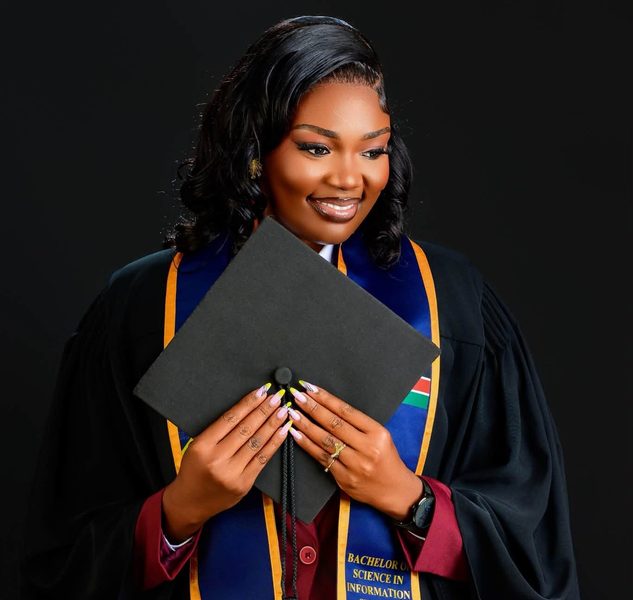
Today, the young woman who once sold water in Juba is a university graduate.
She has completed her studies in Cybersecurity at USIU-Africa in Nairobi.
Her journey has also made her increasingly recognised among young Mundari public figures promoting the community’s culture and traditions, particularly following her visibility during the 2026 Mundari Cultural Festival in Terekeka.
But behind the cultural recognition is a much quieter story. A girl who refused to surrender her education.
A daughter who understood that her father had reached the limits of what he could provide.
And a young woman who kept knocking on doors.
“I can simply say that Dr Benjamin Bol Mel picked me up from the village and changed my life,” she says.
She describes him as her sponsor and says his support came when she had almost lost hope.
“I am deeply proud and grateful for the opportunity he gave me.”
A promise to make the opportunity count
Gemeiza says she wants to honour the people who helped her by working hard and helping others.
“I will always strive to make you proud by doing the right things, working hard, helping others, and continuing to do good as you have done for me and others,” she says.
She also remembers her father.
“I am deeply grateful to my father for supporting my education for as long as he could.”
For her, the degree represents more than academic achievement.
“This graduation is not only a celebration of a degree; it is a testimony that with faith, determination, opportunity, and support, a difficult beginning can lead to a beautiful destination.”
Her story contains no straight road.
It runs through relatives’ homes, streets in Juba, water-selling routes, failed scholarship applications, office compounds, borrowed money, security gates, a cold floor in Mangalla and a long journey back to Gemeiza.
At one point, she had only 5,000 SSP for transport. At another, she had nowhere to sleep.
And for months, she did not know whether the person she was searching for would ever hear her story.
Yet she kept searching.
Now, as she celebrates her graduation thousands of kilometres from the village where her journey began, Gemeiza looks back not at the doors that closed, but at the one that eventually opened.
What began with a young girl asking whether she could continue her education has ended with a university degree in cybersecurity.
And for Gemeiza Kakule Kwajok, that journey has left her with a simple belief:
“A great person attracts great people.”
Above all, she says, she gives thanks to God for guiding her through every difficult moment and giving her the strength to continue when giving up seemed easier.