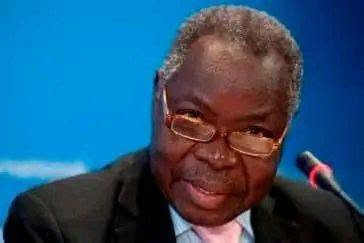
A Tribute to Kosti Manibe Ngai
The passing of Kosti Manibe Ngai is more than the loss of a distinguished South Sudanese public servant. It is the passing of one of the diminishing representatives of a generation that once embodied a very different promise for South Sudan.
Kosti belonged to the mother SPLM—the liberation movement before the privileges of state power, when liberation still carried an ethical purpose and the movement saw itself as custodian of the aspirations of an oppressed people.
He represented the best of that tradition: disciplined, ethical, hardworking, meticulous and exceptionally competent. He was not corrupt in a political environment where corruption increasingly became normalized. He worked relentlessly in a culture where hard work could attract resentment rather than recognition, and where competence itself could provoke jealousy.
Kosti was, quite simply, a public servant when public service was becoming unfashionable.
I knew this personally. He helped bring me back from the United States to work in Africa when I could not return to my own country. South Sudan gave me a home, and Kosti opened that door. Years later, during the post-secession negotiations between Sudan and South Sudan under President Thabo Mbeki, I saw him again as a principal South Sudanese interlocutor on economic matters. His preparation, professionalism and meticulousness earned him respect from all sides.
But Kosti’s death should be more than an occasion for mourning. It should force South Sudan to look into the mirror.
South Sudan entered independence with advantages rarely enjoyed by a new African state: substantial natural resources, extraordinary international goodwill, regional acceptance and, above all, the enormous hope of a people who had sacrificed for generations to achieve freedom.
Much of that inheritance was squandered.
In an extraordinarily short period, liberation too often became entitlement; public office became a route to accumulation; oil wealth fed patronage; ethnicity was weaponized in struggles for power; and political competition repeatedly descended into violence. A state that had barely been built was captured by competing political, military and commercial elites.
Corruption and elite predation are not uniquely South Sudanese. They are an African problem. But South Sudan compressed this familiar African tragedy into a remarkably short period. Those who inherited the state too often behaved as though liberation had transferred ownership of the country to them.
It did not.
South Sudan belongs to its people.
This is why Kosti’s life matters. He is evidence that South Sudan’s failure was not inevitable. There were people within the liberation generation who understood that independence imposed obligations, not privileges; that public money belonged to the public; that competence mattered; and that liberation had to be translated into institutions, citizenship and service.
Kosti was one of the very few.
He worked almost compulsively. He demanded much from himself, perhaps too much. There is a particular sadness in seeing such a dedicated man leave us too soon, after a long illness, while so much of the political culture against which his example stood continues to endure.
And there is another painful lesson. Africa is often generous to its heroes only after they die. We neglect people when they need solidarity and rediscover their virtues at their funerals. Kosti deserved better.
Above all, the people of South Sudan deserve better.
So let his passing be both an indictment and an invitation.
An indictment of corruption, entitlement, ethnic manipulation and the conversion of public office into private wealth.
And an invitation to South Sudan’s younger generation to recover the better tradition that Kosti represented.
Young South Sudanese should know that there was another SPLM tradition—a tradition of discipline, sacrifice, competence and public service. They should know that liberation was never meant to enrich an elite. Its purpose was to emancipate a people.
Kosti’s generation fought to make South Sudan possible. The task of the coming generation is to make South Sudan worthy of the sacrifices that created it.
That would be the monument Kosti deserves: not another speech, not another funeral declaration, but a country in which power is a trust, public resources are sacred, hard work is honoured rather than resented, integrity is stronger than patronage, and government is measured by the dignity of the ordinary citizen.
I mourn Kosti as a friend and mentor. But I remember him above all as proof that another South Sudan was—and remains—possible.
Let his passing disturb the conscience of those who rule.
Let his life inspire those who will come after them.
And let South Sudan return to its people.
May Kosti Manibe Ngai rest in eternal peace.
About the Author
Abdul Mohammed is a former United Nations, African Union, and Sudan Council of Churches official.
The views and opinions expressed in this tribute are solely those of the author and do not necessarily reflect the views, position, or editorial policy of Standard Zone News.