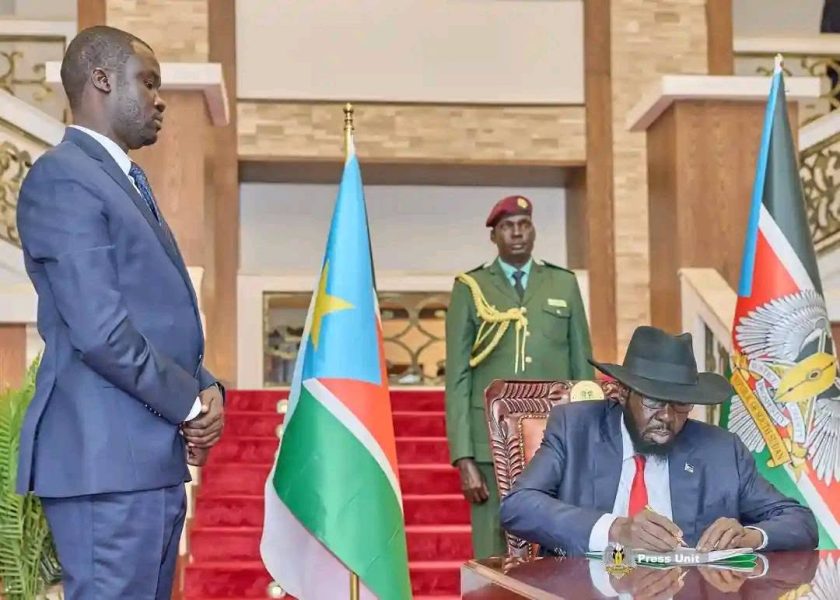
South Sudan’s President Salva Kiir Mayardit has signed Constitutional Amendment No. 13 into law, just a day after lawmakers passed it, in a rapid process that has drawn criticism over the speed and transparency of the changes.
The President’s assent on Wednesday clears the legal pathway for general elections scheduled for 22 December 2026, according to Kiir’s office.
The Transitional National Legislative Assembly approved the amendment on Tuesday.
The legislation amends the Transitional Constitution to align it with the electoral timetable, including by removing legal requirements that elections be tied to the adoption of a permanent constitution and the completion of a national population and housing census.
The speed of the process has fuelled debate among political actors and observers, with critics questioning whether such far-reaching constitutional changes should have been passed and signed within barely 24 hours.
The controversy was heightened by Tuesday’s parliamentary sitting, where journalists and members of the public were barred from observing the debate.
Speaker Joseph Paciko Ngere ordered the media and public to leave the chamber as lawmakers began the second reading of Constitution Amendment Bill No. 13.
Ngere invoked Parliamentary Regulation 24, citing national security, sovereignty, public order and social stability as reasons for closing the sitting.
“Media, out. All everybody there, out,” Ngere told journalists and members of the public.
The exclusion prevented journalists and members of the public from directly following lawmakers’ deliberations on legislation that will shape the country’s electoral and constitutional framework.
The government has defended the amendments as necessary to remove legal obstacles to the December elections and bring the constitutional framework into line with the 2018 peace agreement.
But opposition groups and international partners have questioned whether the country’s security environment, political space and electoral institutions are sufficiently prepared to deliver a credible, peaceful and inclusive vote.
South Sudan has repeatedly postponed elections since gaining independence in 2011.
The current transitional period is due to expire in February 2027, making the December polls a critical test of the country’s transition to elected government.
With the amendment now signed into law, attention is shifting from Parliament’s rapid passage to the bigger question: will the constitutional changes pave the way for elections or deepen concerns that South Sudan’s political rules are being rewritten too quickly and with too little public scrutiny?