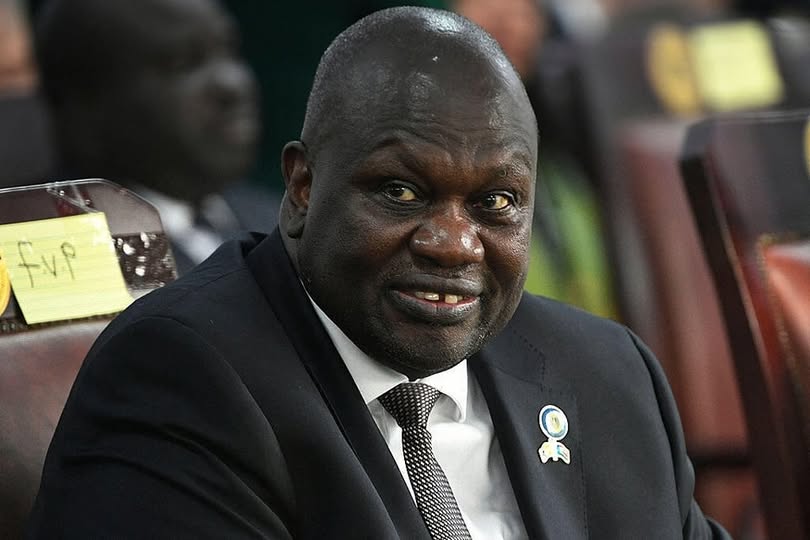
Dr. Riek Machar Teny-Dhurgon has given a detailed account of how he personally pursued every possible avenue to rescue Maj. Gen. David Majur Dak and 26 other SSPDF soldiers who were trapped inside armoured personnel carriers (APCs) following the March 4, 2025, fighting at Wich-Yar-Adiu garrison in Nasir.
Testifying during the 131st session of the Special Court on the Incident of Nasir, in his ninth defense statement, Dr. Machar recounted how he contacted local authorities, military commanders, humanitarian organisations, the President and the United Nations Mission in South Sudan (UNMISS) in an effort to secure the soldiers’ safety and evacuation.
His testimony painted a picture of an unfolding emergency in which the wounded General and his men were trapped, surrounded by insecurity, with limited access to food, water and medical assistance.
From the fall of the garrison to the rescue mission
Dr. Machar told the court that after learning that the Wich-Yar-Adiu garrison had been overrun on the morning of March 4, 2025, he immediately contacted the Commissioner of Nasir and the Governor of Upper Nile to establish what had happened.
Later that morning, the Commissioner informed him that several soldiers had taken shelter inside four APCs and that the garrison commander, Maj. Gen. David Majur Dak, was among them.
He immediately sought to establish direct communication with the General.
“I asked the Commissioner to connect the commander on the line so that we could find a way of rescuing him,” Dr. Machar testified.
When the Commissioner’s attempts to reach the General failed because his phone was offline, Dr. Machar instructed him to obtain another phone from the market and deliver it to the trapped commander to restore communication.
Eventually, through the assistance of Thomas Magok Chuol, an official in his office who had a telephone contact for the General’s bodyguard, communication was established.
Dr. Machar said he asked the General about his condition and learned that he had sustained a gunshot wound to his leg.
“I asked him how he was, he told me that he had been wounded in the leg,” he recounted.
Explored every possible route to get the General out
With the General wounded and unable to move freely, Dr. Machar said he explored several options for getting him out of the dangerous location.
He first proposed taking him to the SPLA-IO Division 3 headquarters at Nyetot, from where he could be transported to Mandeng for evacuation to Juba.
However, the General considered the journey dangerous because armed youth were still present in Nasir.
Dr. Machar then suggested moving him to the Commissioner’s compound, but this option was also considered unsafe. The General could not walk because of his injury, there was no available vehicle, and the distance was approximately three kilometres.
The General eventually explained that the immediate needs of those trapped were food and water.
Dr. Machar told the court:
“I asked him again whether he would go to the compound of the Commissioner of Nasir. He responded that it was also risky because the distance is 3 kilometres, and he could not walk, he had no car, and the Commissioner had no car either; the Commissioner also said it was risky. He then said that what they needed was water and food.”
Recognising that the immediate priority was keeping the stranded soldiers alive, Dr. Machar instructed the Commissioner to arrange the delivery of food and water.
Food and water delivered despite the danger
The humanitarian effort was not without risks. According to Dr. Machar, the Commissioner informed him that soldiers inside an APC near the garrison entrance were reportedly shooting at anyone approaching the vehicle.
He testified that four youths who had been lurking near the APC had reportedly been shot dead.
Despite the danger, Dr. Machar continued searching for a safe way to deliver humanitarian supplies.
“I again asked whether women could be sent to take the food and water,” he told the court.
The Commissioner indicated that this could only happen if the soldiers inside the APC were informed beforehand so that they would not mistake the people delivering the supplies for attackers.
The breakthrough came through family connections. Thomas Magok informed Dr. Machar that the General’s nephew was in Nasir and could help establish trust between the trapped soldiers and those delivering the supplies.
The Commissioner located the young man, who subsequently spoke to his uncle.
Dr. Machar explained:
“That was why it was possible for the food to be delivered despite the tension, as the young man talked to his uncle.”
He added that women and traditional chiefs, led by the General’s nephew, eventually delivered food and water.
“In actual fact, the General and his soldiers spent the nights of the 5th and 6th of March 2025 outside the APCs. Some went to take a bath in the Sobat River.”
Deployed forces to protect the stranded soldiers
Beyond the humanitarian intervention, Dr. Machar testified that he instructed the SPLA-IO Division 3 commander to send forces to Nasir to help secure the garrison and prevent armed youth from harming the stranded personnel.
Although the Division 3 commander initially informed him that he was sick and could not personally travel to Nasir, he agreed to send a force commanded by Brig. Gen. Kong Mayoum.
Dr. Machar said the force was tasked with securing the area, keeping the youth away from the APCs and protecting Maj. Gen. David Majur Dak and his 26 soldiers.
He also testified that he kept the SSPDF Chief of Defence Forces, Gen. Paul Nang Majok, informed about the situation and his efforts.
“I also informed him about my ongoing efforts for the urgent evacuation of Maj. Gen. David Majur and his twenty-six (26) soldiers,” he said.
Dr. Machar noted that Gen. Paul Nang was initially under the impression that fighting was still ongoing.
“I told him that there was no fighting going on.”
Turned to the President, ICRC and United Nations
Having explored local rescue arrangements, Dr. Machar said he proceeded to seek international assistance to evacuate the stranded soldiers.
On March 4, 2025, he wrote to the President requesting the chartering of two 19-seater light aircraft to transport the General and his men from Nasir.
However, rather than waiting for a response, he simultaneously approached the International Committee of the Red Cross (ICRC).
The ICRC informed him that its available helicopter was too small to undertake the operation.
He then contacted UNMISS through Mr. Evan Bwala, who previously facilitated communication between his office and the Office of the Special Representative of the Secretary-General.
Dr. Machar subsequently spoke with the then UNMISS chief, Mr. Nicholas Haysom, who visited his office on March 5, 2025.
During that meeting, he renewed his appeal for an urgent evacuation.
“I told him that the situation was desperate, as the General did not have food and water in addition to the fact that he was wounded,” Dr. Machar testified.
He also explained that the local population respected the United Nations and that UNMISS had previously maintained a base in Nasir.
According to his testimony, Mr. Haysom promised to do his best to facilitate the extraction, although he needed to consult with UN headquarters in New York.
The first helicopters arrive, but the mission is incomplete
Dr. Machar told the court that on the morning of March 6, 2025, the UNMISS chief informed him that two helicopters would arrive in Nasir at approximately 5:30 p.m.
The helicopters subsequently landed at the Nasir airstrip, but transporting the stranded soldiers from the garrison to the airstrip proved difficult because of the security situation.
The Commissioner had no vehicle, and the roads between the garrison and the airstrip were considered unsafe.
The Commissioner therefore communicated with Joseph Malong, asking him to burn a hut to produce smoke that would help the helicopter crews identify the soldiers’ location.
One helicopter eventually landed close to the APC near the garrison entrance.
Dr. Machar recounted that the officer and ten soldiers inside the APC rushed out and boarded the helicopter with their weapons.
“The helicopter then took off, and the other helicopter that was hovering above did not have the time to land. The two went back to Malakal.”
Only 11 soldiers, including officers, were evacuated during that first operation.
The remaining personnel were scheduled for evacuation the following morning.
The final call before the second evacuation
Dr. Machar said he personally continued coordinating the operation and informed Maj. Gen. David Majur Dak that the helicopters would return on March 7.
He also instructed the Commissioner and Maj. Gen. Peter Ruach Wie to be present at the garrison to facilitate the evacuation.
On March 7, at approximately 11:30 a.m., just ten minutes before the helicopters landed, Dr. Machar contacted the General to confirm that everything was ready.
The General confirmed that the Commissioner, Maj. Gen. Peter Ruach Wie and SPLA-IO officers who would assist him in reaching the helicopter were present.
Dr. Machar told the court:
“I wished him a safe journey to Malakal and I promised to see him when he arrived in Juba. We ended our contact.”
He added that the US and German Ambassadors were in his office at the time and heard the conversation.
“They heard my conversation with the General,” he testified.
Rejects allegations that he wanted the General to surrender
In another significant part of his testimony, Dr. Machar rejected prosecution allegations that his proposals to move Maj. Gen. David Majur Dak to the SPLA-IO Division 3 headquarters or the Commissioner’s compound were intended to force the General to surrender to SPLA-IO.
He argued that the suggestions were purely rescue arrangements made in response to the General’s injuries, the dangerous security situation and the absence of safe transportation.
He also challenged the prosecution’s presentation of selected audio recordings, arguing that portions of his conversations had been taken out of context.
Regarding the timing of the UNMISS evacuation, he disputed the dates presented by some prosecution witnesses, insisting that the helicopters arrived in Nasir on March 6 and March 7, 2025.
He emphasised that he had personally handled the communication throughout the operation.
“Your Lordships, I did not assign this mission to anyone in my office; I was the one who handled the communication myself.”
A testimony centred on the effort to save lives
Dr. Machar’s ninth defense statement presented his account of the events surrounding the fall of Wich-Yar-Adiu garrison and the subsequent rescue of the stranded soldiers.
From contacting local authorities and deploying forces to arranging food and water, approaching the President and international humanitarian organisations, and securing UNMISS helicopter assistance, he detailed the different measures he said he undertook to ensure the soldiers’ safety.
His central argument was that his communications and proposals were intended to prevent further casualties and secure the safe evacuation of the wounded General and his men.
The 131st session was adjourned until Monday, November 30, 2026, when Dr. Machar is expected to resume his defense testimony.